1. Introduction
Transport Service Users, Transport Service Organizers, and Transport Operators face a growing need to calculate and report logistics emissions with greater accuracy and transparency. Increasingly, this means moving beyond default and modeled data toward primary data that reflects actual operational emissions.
The methodological foundations for this shift are already in place: ISO 14083:2023 and the GLEC Framework have established a shared basis for emissions accounting. Yet data access processes remain largely manual and vary from company to company, making the exchange of primary emissions data both challenging and costly.
The iLEAP Technical Specifications address this gap by enabling the structured flow of emissions and activity data across organizations and IT systems. They do so by:
-
"working backwards" from concrete business cases (§ 3 Business Cases),
-
translating those business cases into well-defined data transactions (§ 4 Data Transactions) that can be realized through independent software implementations, known as host systems,
-
defining a data exchange protocol (§ 7 HTTP REST API) to unlock the interoperable flow of data between host systems, and
-
introducing a data model (§ 6 Data Model) that aligns with ISO 14083 and the GLEC Framework V3.1.
1.1. Methodological Interoperability
The iLEAP Technical Specifications are based on ISO14083:2023, with which they are methodologically aligned and the GLEC Framework V3.1.
Furthermore, the specifications are designed to be methodologically interoperable with the PACT Methodology Version 2 and Version 3.
The iLEAP Technical Specifications will soon be updated to align with the upcoming GLEC Framework Version 3.3.
1.2. PACT Technical Interoperability
iLEAP is interoperable with the PACT Data Exchange Protocol and its PCF data model (§ 7.11 PACT Integration).
With v1.1.0, the iLEAP standalone protocol (§ 7 HTTP REST API) is introduced as the primary protocol for data exchange, while support for the PACT Data Exchange Protocol is maintained for backward compatibility and fallback purposes.
Note: The PACT Data Exchange Protocol integration is scheduled for removal with the v2.0.0 release of the iLEAP Technical Specifications.
Note: The editors of this specification strive to assert semantical interoperability with the PACT Technical Specifications with future releases.
1.3. Out of Scope
Note: Non-normative section
These specifications do not cover the following topics or aspects, as they are covered elsewhere or declared as out of scope of this specification:
-
Methodology for the calculation of logistics-related emissions. The technical specifications' normative foundations are the [GLEC] Framework and [ISO14083].
-
Black Carbon Methodological and Accounting principles.
-
Technical details on capturing necessary data for primary data-based calculations approaches, such as data collection with or through telematics systems, TMS, etc.
-
Contracts or legal aspect of data exchange between parties, including third party entities offering digital services or tools.
-
Auditing and verification of actual emissions calculations beyond systems-level accreditation. Verification-related properties are expected to be included in future versions of these technical specifications.
-
Market-based accounting approaches (e.g., based on contractual instruments such as energy attribute certificates), project accounting, and book and claim approaches. Emissions from electricity exchanged under these specifications are quantified using the location-based approach as specified in [ISO14083], Annex J.3 (see § 6.7.8.1 Emission Factors of Electricity). Market-based figures, which [ISO14083], Annex J.3 permits only in addition to location-based figures and to be reported separately, are expected to be included in future versions of these technical specifications, as are book and claim-related approaches.
-
Variables for detailed GHG emissions modeling, as described in [ISO14083], Section 13.4.3 and Annex M. The current data model focuses on enabling primary data collection. Basic use of modeled and default data is supported, but detailed parameters remain excluded.
-
Modes of transport "cable car" and "pipeline".
-
The exchange of refrigerant-specific data, such as refrigerant type, leaked quantity, and global warming potential. Leakage of refrigerants used by vehicles or hubs is part of the system boundary of [ISO14083] (Section 5.2.2; see also Section 9.2, Annex H.1.2 and, for transport operations, Annex I); emission values exchanged under these specifications follow it, including the requirement to state any omission (Section 5.2.3). The extent to which emission values include refrigerant leakage is stated with
refrigerantLeakageCoverageandrefrigerantLeakageCoverage. Data model support for refrigerant data is expected in future versions of these technical specifications. -
Reporting with per-modality transparency as defined in Section 13.3 of [ISO14083]. The key difference between this approach and iLEAP is that the former also allows for a) aggregating over more than 1 shipment, and b) disclosing emissions per modality. The iLEAP Technical Specifications operate on a per-shipment and per-TCE basis. However, transparency at this level is implicitly assumed by ISO14083 Chapter 13.3 (when aggregating over multiple shipments). Comprehensive reporting according to [ISO14083] Chapter 13.3 is expected to be included in future versions of these technical specifications.
1.4. Document Statuses
The iLEAP Technical Specifications adhere to the SemVer standard and are published according to a flow that clearly distinguishes work-in-progress from pre-releases and stable releases. These are indicated by the status tag below at the top of the document. Possible status tags are:
- Living Document
-
Work-in-progress. The version number is typically extended with the date on which the most recent changes were made (e.g., 0.2.1-20240523). Accessible at https://specs.ileap.global/.
- Consultation Draft
-
Pre-release. Distributed for the purpose of obtaining community feedback. No further significant changes will be made until the release. Minor corrections may still be possible. Every Consultation Draft is assigned a stable, permanent, URL, e.g., https://specs.ileap.global/TR/2024/ileap-extension-20240521/.
- Release
-
Stable release. No further changes will be made to this version. Any additional changes will be included in subsequent versions. Every Release is assigned a stable, permanent, URL, e.g., https://specs.ileap.global/TR/2024/ileap-extension-20240605/.
1.5. Acknowledgements
The iLEAP Technical Specifications are the result of a collaborative effort by numerous iLEAP project participants.
The authors would like to thank the many individuals and organizations for their contributions and their commitment to iLEAP in the various phases of its development.
2. Definitions and Conventions
2.1. ISO14083- and GLEC-Framework-related Definitions
- Actual Distance
-
The actual route (with unit
kilometer) taken for a consignment. [GLEC] Framework. See also [ISO14083] Section 3.1.27.1. - Consignment
-
Refers to a quantifiable quantity of cargo that can be distinctly identified as a single unit. It is transported from a sender or consignor to a receiver or consignee, irrespective of the mode of transportation employed. See [ISO14083], Section 3.1.4.
- Consignment id
-
A digital identifier which uniquely identifies a Consignment relative to the Host system and to the data recipient.
- Default Value
-
Secondary data value taken from a published source, e.g. a default value of the [GLEC] Framework. A default value does not necessarily correspond to the parameters of the transport operation or hub operation being evaluated. See [ISO14083], Section 3.3.4.2 and Annex Q.
- Distance
-
See Transport Distance and Actual Distance
- Great Circle Distance (GCD)
-
The shortest distance between two points by crow-line, including the curving of the Earth. It is an approach used in air transport. [GLEC] Framework.
- Hub
-
Location where freight is transferred from one vehicle or transport mode to another before, after, or between the elements of a transport chain, e.g. cross-docking sites, distribution centres, warehouses, rail/road terminals, and terminals at seaports, inland ports, and airports. See [ISO14083], Section 3.1.8 and Annex H.
- Hub Activity
-
Parameter that quantifies the throughput of a hub. For freight, hub activity is the quantity of freight leaving the hub (outbound), expressed in the unit given by
hubActivityUnit. Hub activity is not transport activity (see § 2.4 Transport Activity and Hub Activity). See [ISO14083], Sections 3.1.9, 5.5.2 and 9.4.1, and the [GLEC] Framework. - Hub Equipment
-
Equipment and facilities used at a hub to transfer freight, e.g. handling, on-site transportation, and transhipment equipment, including heating and temperature control. See [ISO14083], Sections 3.1.10 and 5.2.2.
- Hub Operation
-
Operation to transfer freight through a hub. See [ISO14083], Section 3.1.11.
- Hub Operation Category (HOC)
-
Represents a group of hub operations sharing similar characteristics. See [ISO14083], Section 3.1.12, and the [GLEC] Framework.
- Hub Operator
-
Refers to the entity that carries out hub operations involving freight. See [ISO14083], Section 3.1.13.
- Hub Service
-
Service provided within a hub TCE. See [ISO14083], Section 3.1.14.
- Hub TCE
-
A TCE within which the freight transits through a single hub, i.e. a TCE taking place within a hub operation. A hub TCE is represented by a
TCEthat references aHOCthroughhocId(see § 6.2.2 Hub TCEs). See [ISO14083], Clause 11. - Modeled Data
-
Secondary data established by use of a model that takes into account primary data and/or GHG emission-relevant parameters of a transport operation or hub operation, such as vehicle size, load factor, or fuel type. See [ISO14083], Section 3.3.4.1.
- Primary Data
-
Quantified value of a process or an activity obtained from a direct measurement or a calculation based on direct measurements. Primary data can include GHG emission factors and/or GHG activity data. See [ISO14083], Section 3.3.3, and the [GLEC] Framework.
- Secondary Data
-
Data that do not meet the requirements for primary data. Secondary data are either modeled data or default values. See [ISO14083], Section 3.3.4, and the [GLEC] Framework.
- Shipment
-
A shipment refers to the goods in a commercial transaction between a seller and a buyer. Refers to the consignments transported as part of this transaction via a transport chain from the consignor to the consignee. See [ISO14083], Section 3.1.20.
- ShipmentFootprint
-
See § 6.1 ShipmentFootprint for the definition.
- Shipment id
-
A digital identifier which uniquely identifies a Shipment relative to the Host system and to the Data recipient.
- Shipper
-
Refers to the party sending goods for transport; e.g. buying transport services from Transport Service Organizers or Transport Operators. See [GLEC] Framework.
- Shortest Feasible Distance (SFD)
-
Represents the shortest practical route between two places taking into account the real operating conditions. [GLEC] Framework.
- Throughput
-
The quantity of freight that is handled, sorted, cross-docked, or transferred at a hub, within or between transport modes. See [ISO14083], Section 3.1.21.
- Transport Activity
-
Transport activity for each consignment is calculated by multiplying the consignment’s mass by the TCE distance. It is measured with unit
tonne-kilometer. See [ISO14083] Section 3.1.24 and the [GLEC] Framework. It does not include hub activity (see § 2.4 Transport Activity and Hub Activity). - Transport Chain (TC)
-
A Transport Chain as defined in the [GLEC] Framework. A TC consists of 1 or more Transport Chain Elements. A TC corresponds to a shipment.
- Transport Chain Element (TCE)
-
Section of a transport chain within which the freight is carried by a single vehicle or transits through a single hub. A TCE therefore relates either to transport activity or to hub activity. See [ISO14083], Section 3.1.26, and the [GLEC] Framework.
- Transport Distance
-
Refers to the distance covered from the consignor to the consignee during the transportation of the freight. [GLEC] Framework. See also [ISO14083] 3.1.27.
- Transport Operation
-
Operation of a vehicle to transport freight. See [ISO14083], Section 3.1.28.
- Transport Operation Category (TOC)
-
Represents a group of transport operations sharing similar characteristics. See [ISO14083], Section 3.1.29, and the [GLEC] Framework.
- Transport Operator
-
Refers to the entity that carries out transport operations involving the carriage of freight. See [ISO14083], Section 3.1.30.
- Transport Service
-
Service provided to a Transport Service User for the transport of freight from an origin to a destination. A transport service can comprise several Transport Chain Elements and require both transport operations and hub operations. See [ISO14083], Section 3.1.31.
- Transport Service Organizer
-
Refers to the party providing transport services, where some of the operations are subcontracted to a third party, usually a Transport Operator. See [ISO14083], Section 3.1.32.
- Transport Service User
-
Refers to the party that purchases and/or utilizes a transport service. It could be a shipper or a Transport Service Organizer. See [ISO14083], Section 3.1.33.
- Tool Provider
-
Provider of software, tools, services, or programs that support companies in calculating and reporting logistics GHG emissions conforming to these technical specifications.
2.2. Auxiliary Definitions
- Access Token
-
Credential to provide access to protected resources, as defined in [rfc6749] Section 1.4 (see also Section 5.1 and Appendix A.12).
- Data Owner
-
The party in the logistics value chain that owns the data being exchanged.
- Data Recipient
-
The party in the logistics value chain requesting and/or receiving the data being exchanged.
- Host System
-
A host system serves the needs of a single or multiple data owner. Additionally, it can also serve the needs of a data recipient, by calling the HTTP REST API defined in § 7 HTTP REST API. A host system implements support for the data transactions defined in § 4 Data Transactions.
- iLEAP standalone protocol
-
The iLEAP standalone API and data model, introduced in v1.1.0 of these technical specifications, which enables the exchange of logistics emissions. See § 7 HTTP REST API for details.
- OpenId Provider Configuration Document
-
An OpenId Provider Configuration Document in accordance with [OPENID-CONNECT] section 4.
- PCF
-
Product Carbon Footprint. See PACT Technical Specifications for further details.
- Smart Freight Centre (SFC)
-
The Smart Freight Centre Organization.
2.3. Conventions
The key words "MUST", "MUST NOT", "REQUIRED", "SHALL", "SHALL NOT", "SHOULD", "SHOULD NOT", "RECOMMENDED", "NOT RECOMMENDED", "MAY", and "OPTIONAL" in this document are to be interpreted as described in (BCP14)[https://www.rfc-editor.org/info/bcp14] [RFC2119] [RFC8174] when, and only when, they appear in all capitals, as shown here.
2.4. Transport Activity and Hub Activity
Transport Activity and Hub Activity are distinct quantities. They MUST NOT be summed, converted into each other, or used interchangeably.
-
Transport Activity quantifies the transport of freight by vehicles. Its unit is
tonne-kilometerunless stated otherwise (seetransportActivityUnit). -
Hub Activity quantifies the throughput of a hub. Its unit is the one given in
hubActivityUnit, e.g.tonnesleaving the hub. -
The transport activity of a transport chain or of a set of shipments is the sum of the transport activity of its TCEs representing transport operations only. Hub TCEs contribute GHG emissions, but no transport activity (see § 6.2.2 Hub TCEs and [ISO14083], Sections 12.1.2 and 12.2.3).
-
GHG emissions of hub operations result from hub equipment operation and hub equipment energy provision (see [ISO14083], Sections 3.2.8.1 and 3.2.8.2), not from vehicle operation.
2.5. Forward Compatibility
To allow these specifications to evolve in minor versions (see § 1.4 Document Statuses):
-
A data recipient MUST ignore properties not defined in the version of these specifications it implements and MUST NOT reject a data object for this reason alone.
-
New enumeration values MAY be added in minor versions. Enumeration values are only removed or renamed in major versions; they are deprecated in a minor version first.
-
Host systems MUST only use enumeration values defined in these specifications.
-
A data recipient receiving an unknown enumeration value MUST NOT reject the response or other data objects contained in it, MUST NOT map the value to a known value, SHOULD treat the affected property as not interpretable, and SHOULD inform its user accordingly.
These rules apply to all enumerations of these specifications, including those defined inline in property descriptions.
3. Business Cases
Note: Non-normative section
These specifications shall serve the general need of businesses for logistics GHG emissions accounting and reporting, conforming to the [GLEC] Framework and [ISO14083].
Given the nature of the logistics industry, and in order to reduce costs overall, these specifications aim at enabling interoperability in the exchange of emissions data between different parties in the logistics value chain.
To achieve this objective, the specifications are guided by a set of business cases which provide the framework for delineating subsequent data transactions and the iLEAP data model.
3.1. Quantification of (Avoided) Emissions
A Transport Service User requests its Transport Service Organizers or Transport Operators to provide it with the GHG emissions of Shipments. The transport service user is interested in accessing accurate emission and emission intensity values based on actual measurements ("primary data").
Accurate logistics emissions values also enable the Transport Service User to compare logistics emissions and the resulting reductions from operational measures.
Data Transactions 1 (§ 4.1 Data Transaction 1: TCE Data Exchange) and 2 (§ 4.2 Data Transaction 2: TOC or HOC Data Exchange) enable this business case.
3.2. Procurement of Carbon-Efficient Logistics Services
A Transport Service Organizer requests their Transport Operators to share GHG emission intensity information at the TOC or HOC level. Similarly, a Transport Service User requests intensity information from its Transport Service Organizers and Transport Operators.
By incorporating emission intensities in procurement processes, the parties are enabled to select services by carbon-efficiency advantages.
Data Transaction 2 § 4.2 Data Transaction 2: TOC or HOC Data Exchange enable this business case.
3.3. Emissions Calculation from Transport Activity Data
Consider the two following scenarios:
-
A Transport Operator, and possibly also Transport Service Organizer, is not yet able to calculate GHG emissions according to the GLEC Framework and [ISO14083].
-
A stakeholder collects primary data related to transport activity but is not in the business of calculating emissions data.
In each case, the party can collect Transport Activity Data, that is, data related to a single shipment including mass, distance, and energy carriers used, but excluding emissions data.
After collecting Transport Activity Data, the party can calculate TOC and HOC level data from its Transport Activity Data, either inhouse or by contracting a third party (such as a Tool Provider).
This business case is particularly relevant for SMEs to reduce the entry barrier for logistics emissions reporting.
iLEAP generally simplifies data collection efforts for the parties involved in this business case. For instance, each party needs to collect the activity data only once. This data can be then made available to multiple parties for different purposes, including business cases beyond emissions calculations.
Data Transaction 3 (§ 4.3 Data Transaction 3: Transport Activity Data Exchange) enables this business case.
3.4. Aggregated Emissions Reporting
Consider the following scenarios:
-
A Transport Service Organizer or a Transport Service User requests emissions data from a Transport Operator or a Transport Service Organizer which decide to share an aggregated report instead of TCE-level data, due to privacy or competition concerns.
-
A Transport Service User or a Transport Service Organizer requests emissions reports from a Transport Operator or a Transport Service Organizer, aggregated per transport mode or over one or more shipments.
-
A Transport Service User, a Transport Service Organizer, or a Transport Operator needs to report logistics emissions data to a public body for regulatory purposes.
Data Transaction 4 (§ 4.4 Data Transaction 4: Aggregated Emissions Data Exchange) enables this business case, while Data Transactions 1, 2, and 3 support the collection of relevant input data for report calculations (see § 4.1 Data Transaction 1: TCE Data Exchange, § 4.2 Data Transaction 2: TOC or HOC Data Exchange, § 4.3 Data Transaction 3: Transport Activity Data Exchange).
3.5. Additional Business Cases
- Disclosure of Logistics Emissions as part of PCFs
-
A Transport Service User is requested to disclose logistics emissions as part of a PCF. A Transport Service User can disclose this data as a data model extension (see § 7.11.1 ShipmentFootprint).
This is enabled through the usage of the PACT Technical Specifications and disclosing through so-called Data Model Extensions based on the iLEAP Data Model (§ 6 Data Model). See the PACT [DATA-MODEL-EXTENSIONS] specifications.
- Forecasting
-
A Transport Service User requests their service provider (Transport Service Organizer or Transport Operator) to share GHG emissions at the TOC or HOC level. This enables the Transport Service User to forecast emissions related to specific activities or services, before these take place.
4. Data Transactions
Note: Non-normative section
A data transaction is an abstraction for the exchange of data between two parties, serving one or more business cases (§ 3 Business Cases).
It facilitates interoperability between different parties by explaining the context and their intentions.
Each transaction enables interoperability between host systems by exchanging data in the format defined by the iLEAP data model (§ 6 Data Model) through the protocols defined in § 7 HTTP REST API and the PACT Data Exchange Protocol (§ 7.11 PACT Integration).
The following diagram shows how data transactions 1, 2, and 3 are related:
A new diagram reflecting Data Transaction 4 is needed.
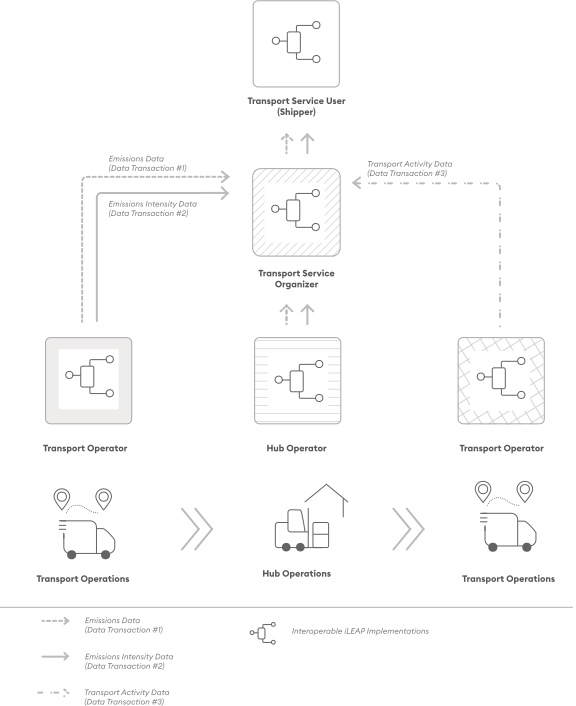
Note: A Tool Provider can assume various roles on behalf of the Transport Service User, Transport Service Organizer, or Transport Operator. They can serve as mediators in activities involving data collection, calculation, and reporting.
4.1. Data Transaction 1: TCE Data Exchange
This data transaction enables a Transport Service User (for example, a shipper) to receive emissions from Transport Chain Elements from a Transport Operator or a Transport Service Organizer for a single shipment.
To execute this transaction, the Transport Operator or the Transport Service Organizer MUST
-
calculate the emissions of 1 or more Transport Chain Elements in accordance with the [GLEC] Framework and [ISO14083], and then
-
make the resulting
ShipmentFootprintavailable to the Transport Service User through the (recommended) iLEAP standalone protocol (§ 7.6 Action ShipmentFootprintData) and through the (deprecated) PACT Data Exchange Protocol (§ 7.11.1 ShipmentFootprint).
The Transport Service User CAN then derive emissions using the shipment id, by
-
collecting the
TCEsfrom theShipmentFootprintsof all the Transport Operators and the Transport Service Organizers involved in the shipment; -
forming the TC from the collected TCEs;
-
calculating the logistics emissions of the shipment in accordance with the [GLEC] Framework and [ISO14083].
Note: For an example exchange, see § 5 End-to-End Example.
4.2. Data Transaction 2: TOC or HOC Data Exchange
This data transaction enables a Transport Service Organizer or a Transport Service User to receive TOC or HOC emission intensity data from a Transport Operator.
The provision of emission intensity data at the TOC or HOC level enables the Transport Service Organizer or Transport Service User to collect the necessary information to calculate emissions according to the GLEC Framework and [ISO14083]. It also facilitates the inclusion of emission intensity in procurement processes, allowing for the provision of services that offer carbon-efficiency advantages (see Business Case 2).
To execute this transaction, first the Transport Operator or Transport Service Organizer MUST
-
calculate 1 or more TOC or HOC emission profiles in accordance with the [GLEC] Framework and [ISO14083], and then
-
make the resulting
TOCsorHOCsavailable through the iLEAP standalone protocol (§ 7.7 Action TOCData and § 7.8 Action HOCData) and through the PACT Data Exchange Protocol (see § 7.11 PACT Integration).Note: Details on the definition and calculation of TOCs and HOCs are specified in [ISO14083] and guidance is provided in the [GLEC] Framework.
Then, a Transport Service Organizer or a Transport Service User can
retrieve the TOCs or HOCs using the (recommended)
iLEAP standalone protocol (§ 7.7 Action TOCData and § 7.8 Action HOCData)
or the (deprecated) PACT Data Exchange Protocol (§ 7.11.1 ShipmentFootprint).
(see § 7.11 PACT Integration for details).
4.3. Data Transaction 3: Transport Activity Data Exchange
Note: This data transaction is considered necessary by logistics parties, especially SMEs, lacking the capabilities to make emissions data available. Yet, standardizing the exchange of activity data can enable the use of primary data and facilitate the calculation of emissions data.
This data transaction enables a Transport Service Organizer or a Transport Service User to receive Transport Activity Data from a Transport Operator, as described in Business Case 3 (§ 3.3 Emissions Calculation from Transport Activity Data).
Using Data Transaction 3 is recommended for the following cases:
-
emissions data (at the level of
ShipmentFootprints,TOCs, orHOCs) is not (yet) available, or -
the data flow is used to calculate emissions data, e.g. by a Tool Provider on behalf of a Transport Service Organizer or a Transport Operator.
To enable this transaction, the data owner (a Transport Operator or Transport Service Organizer) must
-
collect Transport Activity Data scoped by a single consignment, and then
-
make the resulting
TADavailable through § 7.9 Action TransportActivityData.
Then, the Transport Service Organizer or Transport Service User can retrieve
the TADs through the ileap standalone protocol using § 7.9 Action TransportActivityData).
4.4. Data Transaction 4: Aggregated Emissions Data Exchange
This data transaction enables a Transport Service Organizer, a Transport Service User, or
Public Authorities to receive emissions data related to one or more shipments from a Transport Operator, a Transport Service Organizer, or a Transport Service User, without disclosing
TCE-level data. The data exchanged through this transaction MAY disclose emissions aggregated per
transport mode and an aggregation of all hub TCEs (as requested in [ISO14083] Chapter 13.3.2, see
information"j)").
To execute this transaction, a Transport Operator or Transport Service Organizer MUST:
-
calculate all
TCEs' emissions corresponding to the shipment(s) in accordance with the GLEC Framework and ISO 14083, -
generate the
AggregatedReportfrom the collectedTCEs, and -
make the
AggregatedReportavailable to a Transport Service Organizer, Transport Service User, or Public Body, through an iLEAP Conformant API.
Aggregated Emissions Data is less granular than TCE-level data. Therefore, once Aggregated Emissions Data is exchanged, it is no longer possible to derive more granular (i.e., TCE-level) data from it, thereby affecting the all data exchanges downstream. Please consider this when opting for this data transaction.
4.4.1. Examples
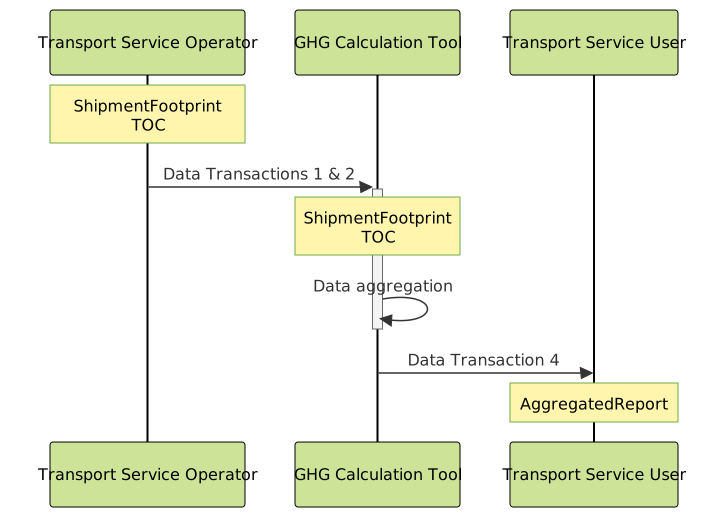
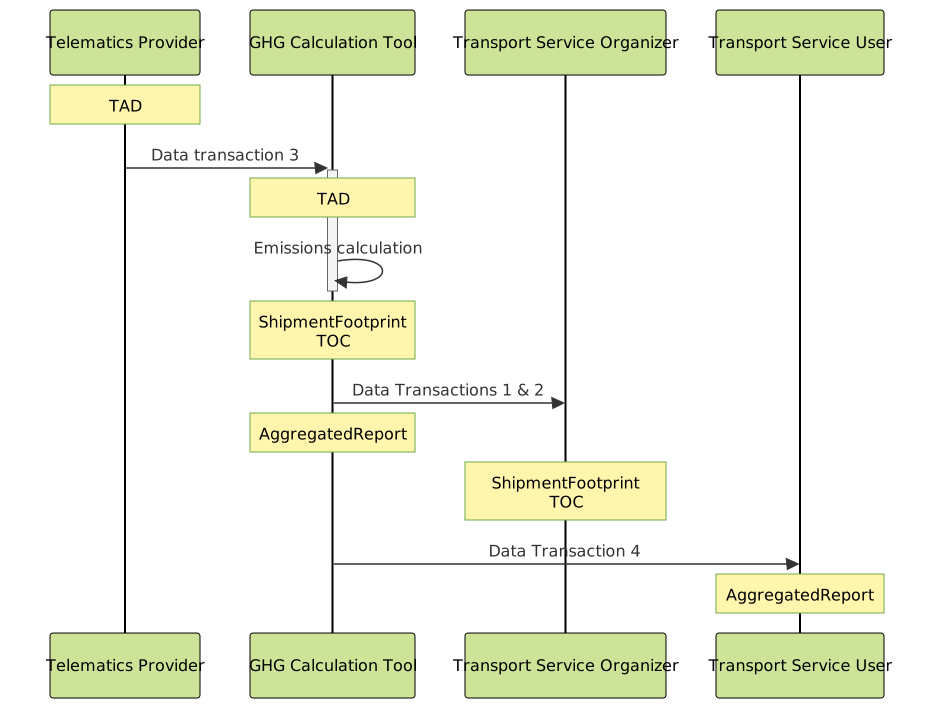
Note: The following are are usecase examples, where a Transport Service Organizer and a Telematics Provider send data to a GHG Calculation Tool with the goal of having the emissions calculated and aggregated, in order to share less granular data with a Transport Service User.
5. End-to-End Example
Note: Non-normative section
Missing example with Data Transaction 4.
5.1. Example Case with 2 Carriers and 1 LSP
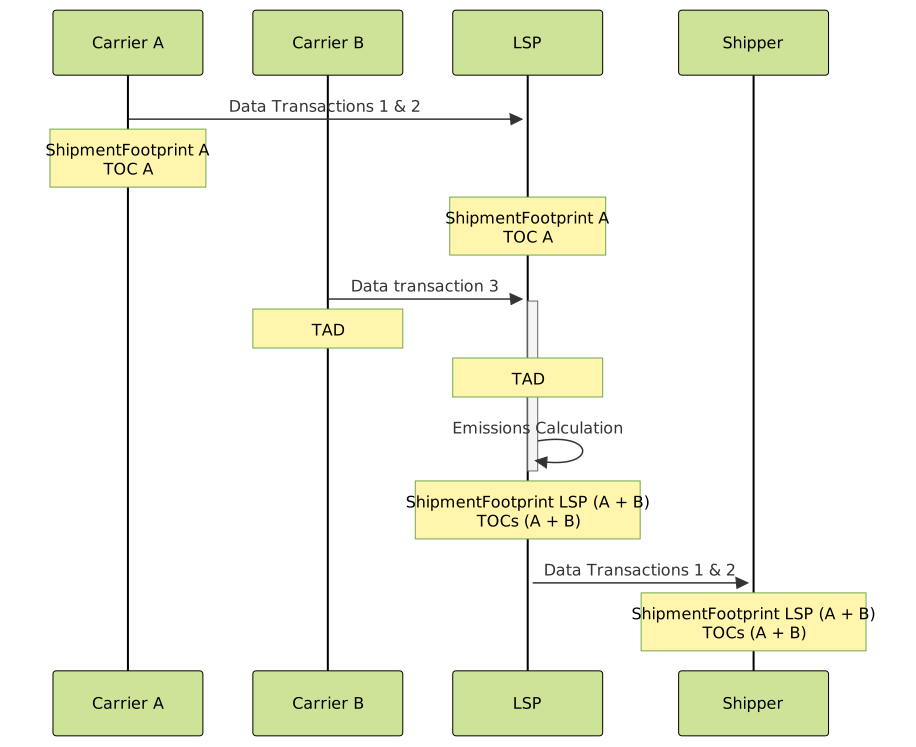
This section provides an end-to-end example of how the (§ 4 Data Transactions) enable logistics emissions transparency for a single shipment.
- Transport Service User
Shipper -
A Transport Service User who wants to calculate the logistics emissions of a shipment from Rotterdam to Prague. The shipper has a contract with the Transport Service Organizer
LSP.Using § 4.1 Data Transaction 1: TCE Data Exchange and § 4.2 Data Transaction 2: TOC or HOC Data Exchange,
ShipperpullsTCEandTOCdata fromLSPand calculates the Transport Chain (TC) emissions.Since no further Transport Service Organizer or Transport Service Operator is involved, no additional calculation is needed.
- Transport Service Organizer
LSP -
A Transport Service Organizer responsible for a shipment from Rotterdam to Prague.
The Transport Service Organizer contracts Transport Operator
Carrier Aand Transport OperatorCarrier Bto perform the transport.Using § 4.1 Data Transaction 1: TCE Data Exchange and § 4.2 Data Transaction 2: TOC or HOC Data Exchange,
LSPpullsTCEandTOCdata from Transport OperatorCarrier A.Using § 4.3 Data Transaction 3: Transport Activity Data Exchange,
LSPpullsTransport Activity DatafromCarrier B, which it uses to calculate emissions data for the shipment.LSPthen calculates the consolidated ShipmentFootprint and provides it to Transport Service UserShipper. - Transport Operator
Carrier A -
A Transport Operator responsible for the first leg of the shipment.
This Operator has a host system which is capable of calculating
TCEandTOCdata.Through this,
Carrier Acan make Transport Chain Element-level data available to the Transport Service OrganizerLSP, whichLSPcan fetch using § 4.1 Data Transaction 1: TCE Data Exchange. - Transport Operator
Carrier B -
Another Transport Operator responsible for the second leg of the shipment.
This Transport Operator is capable of making
TADdata available to the Transport Service OrganizerLSP.
5.1.1. Data Collection by Transport Service Organizer LSP
To collect the TCEs from Transport Operator Carrier A, LSP performs the following HTTP call.
Note: The call to /footprints can return several footprints, one for each shipment.
By filtering, e.g. by shipment id, LSP can retrieve the TCEs for
the shipment of interest. The use of this functionality is not included in the example below.
The highlighted lines show the data exchanged according to the ShipmentFootprint data model.
Consider having an example with the iLEAP standalone protocol instead, moving this to the examples section.
curl -X'GET' \ 'https://api.transport-operator-a.com/2/footprints' \ -H'accept: application/json' \ -H'Authorization: Bearer [access-token]'
Example response:
{ "id" : "d9be4477-e351-45b3-acd9-e1da05e6f633" , "specVersion" : "2.0.0" , "version" : 0 , "created" : "2022-05-22T21:47:32Z" , "status" : "Active" , "companyName" : "Super Duper Transport Co." , "companyIds" : [ "urn:epc:id:sgln:4063973.00000.8" ], "productDescription" : "Logistics emissions related to shipment with ID 1237890" , "productIds" : [ "urn:pathfinder:product:customcode:vendor-assigned:1237890" ], "productCategoryCpc" : "83117" , "productNameCompany" : "Shipment with ID 1237890" , "comment" : "" , "pcf" : { "declaredUnit" : "ton kilometer" , "unitaryProductAmount" : "36.801" , "pCfExcludingBiogenic" : "3.6801" , "fossilGhgEmissions" : "3.6801" , "fossilCarbonContent" : "0.0" , "biogenicCarbonContent" : "0.0" , "characterizationFactors" : "AR5" , "crossSectoralStandardsUsed" : [ "GHG Protocol Product standard" ], "productOrSectorSpecificRules" : [], "boundaryProcessesDescription" : "SFC GLEC Framework-conforming (W2W CO2e emissions)" , "referencePeriodStart" : "2021-01-01T00:00:00Z" , "referencePeriodEnd" : "2022-01-01T00:00:00Z" , "secondaryEmissionFactorSources" : [ { "name" : "GLEC" , "version" : "3.0" } ], "exemptedEmissionsPercent" : 0.0 , "exemptedEmissionsDescription" : "" , "packagingEmissionsIncluded" : true , "primaryDataShare" : 100.0 }, "extensions" : [ { "specVersion" : "2.0.0" , "dataSchema" : "https://api.ileap.sine.dev/shipment-footprint.json" , "data" : { "mass" : "87" , "shipmentId" : "1237890" , "tces" : [ { "tceId" : "abcdef" , "prevTceIds" : [], "tocId" : "truck-40t-euro5-de" , "shipmentId" : "1237890" , "mass" : "87" , "distance" : { "actual" : "423" }, "transportActivity" : "36.801" , "co2eWTW" : "3.6801" , "co2eTTW" : "3.2801" } ] } } ] }
LSP can further access the TOCs from Carrier A through the same endpoint (see § 4.2 Data Transaction 2: TOC or HOC Data Exchange and § 7.11.2 TOC).
5.1.2. Data Collection by LSP from Carrier A
To collect the TCE data related to the shipment, LSP performs the following HTTP call, yielding 2 TCEs in this hypothetical example.
Note: The highlighted lines show 2 TCEs which Carrier A has collected and calculated for LSP.
Consider having an example with the iLEAP standalone protocol instead, moving this to the examples section.
curl -X'GET' \ 'https://api.transport-organizer.com/2/footprints' \ -H'accept: application/json' \ -H'Authorization: Bearer [access-token]'
Example response:
{ "id" : "fb1faac2-7712-458a-a1db-bace3a44abb4" , "specVersion" : "2.0.0" , "version" : 0 , "created" : "2022-05-22T21:47:32Z" , "status" : "Active" , "companyName" : "Transport Organizer Z" , "companyIds" : [ "urn:epc:id:sgln:123456.00000.8" ], "productDescription" : "Logistics emissions related to shipment with ID 1237890" , "productIds" : [ "urn:pathfinder:product:customcode:vendor-assigned:shipment:1237890" ], "productCategoryCpc" : "83117" , "productNameCompany" : "Shipment with ID 1237890" , "comment" : "" , "pcf" : { "declaredUnit" : "ton kilometer" , "unitaryProductAmount" : "64.728" , "pCfExcludingBiogenic" : "8,42769" , "fossilGhgEmissions" : "8,42769" , "fossilCarbonContent" : "0.0" , "biogenicCarbonContent" : "0.0" , "characterizationFactors" : "AR5" , "crossSectoralStandardsUsed" : [ "GHG Protocol Product standard" ], "productOrSectorSpecificRules" : [], "boundaryProcessesDescription" : "SFC GLEC Framework-conforming (W2W CO2e emissions)" , "referencePeriodStart" : "2021-01-01T00:00:00Z" , "referencePeriodEnd" : "2022-01-01T00:00:00Z" , "secondaryEmissionFactorSources" : [ { "name" : "GLEC" , "version" : "3.0" } ], "exemptedEmissionsPercent" : 0.0 , "exemptedEmissionsDescription" : "" , "packagingEmissionsIncluded" : true , "primaryDataShare" : 56.85 }, "extensions" : [ { "specVersion" : "2.0.0" , "dataSchema" : "https://api.ileap.sine.dev/shipment-footprint.json" , "data" : { "mass" : "87" , "shipmentId" : "1237890" , "tces" : [ { "tceId" : "abcdef" , "prevTceIds" : [], "tocId" : "truck-40t-euro5-de" , "shipmentId" : "1237890" , "mass" : "87" , "distance" : { "actual" : "423" }, "transportActivity" : "3.6801" , "co2eWTW" : "3.6801" , "co2eTTW" : "3.2801" }, { "tceId" : "ghijkl" , "prevTceIds" : [ "abcdef" ], "tocId" : "operator-z-truck-89sdff" , "shipmentId" : "1237890" , "mass" : "87" , "distance" : { "actual" : "321" }, "transportActivity" : "27.927" , "co2eWTW" : "4.74759" , "co2eTTW" : "4.272831" } ] } } ] }
6. Data Model
The iLEAP data model of this chapter together with the data transactions (§ 4 Data Transactions) build upon ISO 14083 and the GLEC Framework. The purpose of the data model is to define the syntax and semantics with the goal of enabling the interoperable exchange of data between a data owner and a data recipient using the HTTP REST API (§ 7 HTTP REST API).
The data model is composed of six main data types organized into two categories.
The first category covers emissions data aligned with ISO 14083. At its
foundation are the data types TCE, TOC, and HOC, corresponding to the ISO 14083
concepts of TCE, TOC, and HOC. Building on these,
the data model defines two complementary approaches to emissions reporting in line with
ISO 14083 reporting principles: ShipmentFootprint, which represents the footprint of an
individual shipment across its transport chain, and AggregatedReport, which
facilitates the exchange of aggregated emissions data, e.g. for reporting to public authorities
and to avoid disclosing sensitive data.
The second category covers activity data. TAD (transport activity data, TAD)
enables reporting in case of missing data or limited emissions calculation capabilities from e.g.
Transport Operators.
ShipmentFootprints, TOCs, and HOCs can also be embedded as
data extensions in the PACT Data Model ([PACTDX]) (see [DATA-MODEL-EXTENSIONS] and
§ 7.11 PACT Integration) in a ProductFootprint.
M* are mandatory when using the iLEAP standalone protocol, but
optional when exchanging iLEAP data as a PACT Data Model Extension, as they are already mandatory in
the PACT Data Model (see § 7.11 PACT Integration).
6.1. ShipmentFootprint
The ShipmentFootprint data type enables reporting at the
level of transport or hub services for a single shipment, aligned with
ISO 14083 (Chapter 13.3) and the GLEC Framework.
A ShipmentFootprint covers one or more Transport Chain Elements and
their respective emissions, encoded as TCEs. By collecting one or
more ShipmentFootprints, a Transport Chain (TC) and its emissions
data can be assembled together ultimately enabling the calculation of the
shipment’s logistics emissions.
Note: A ShipmentFootprint CAN include TCEs that the data owner collected from other parties.
6.1.1. Data Attributes
A ShipmentFootprint has the following properties:
Consider adding declaredUnit
| Property | Type | Req | Specification |
|---|---|---|---|
specVersion
| String | M* |
The version of the iLEAP Technical Specifications to which the data conforms, expressed as a string in the format MAJOR.MINOR.PATCH, following Semantic Versioning 2.0.0 (see [SEMVER]).
For the present version, the value MUST be |
companyName
| String | M* | The name of the company owning the data. |
companyIds
| String[] | O |
The non-empty set of strings where each value uniquely identifies the data owner. add coding examples, possibly including URN-based encodings aligning with PACT’s or other approaches. Community input needed on the preferred approach to encoding company identifiers: URN vs UUID, e.g. |
description
| String | O | A description of the Shipment. |
createdAt
| String | M* |
Timestamp of the creation of the ShipmentFootprint.
|
status
| String | M |
Each ShipmentFootprint MUST include the property status with value one of the following
values:
|
referencePeriodStart
| String | M* |
Timestamp of the start (including) of the time boundary for which the data is considered to be representative.
The value MUST be a date and time string conforming to ISO 8601 with timezone UTC. This start date represents the earliest date from which activity data was collected to include in the emissions calculation. Needs revision |
referencePeriodEnd
| String | M* |
Timestamp of the end (excluding) of the time boundary for which the data is considered to be representative.
The value MUST be a date and time string conforming to ISO 8601 with timezone UTC. This end date represents the latest date until which activity data was collected to include in the emissions calculation. Needs revision |
secondaryEmissionFactorSources
| Object[] | O |
The non-empty set of the secondary emission factor sources used for the calculation of the emissions data.
Each element of the array MUST be an object with the following properties:
proposed attribute pending community input |
pactPds: Decimal
| String | O |
The share of primary data in percent used for the calculation of the emissions data, expressed as a value between 0 and 100 (both inclusive), as defined in the PACT Methodology v3.
proposed attribute pending community input |
comment
| String | O |
Additional information related to the Shipment.
SHOULD be used for information and instructions related to the calculation of the data, or other information which informs the ability to interpret, to audit or to verify it. proposed attribute pending community input |
mass : Decimal
| String | M | The mass of the good (in kilograms) and the packaging provided for transport by the Transport Service User, excluding any additional packaging or handling equipment used by the Transport Operator or Transport Service Organizer.
|
volume : Decimal
| String | O | The volume of the freight (in cubic metres) and any packaging provided by the Transport Service User.
|
shipmentId
| String | M | The shipment id of the shipment related to this ShipmentFootprint.
|
tces
| TCE[]
| M | The non-empty array of TCEs relating to this shipment. |
6.2. Transport Chain Element (TCE)
The TCE data type models information related to a single Transport Chain Element and its emissions data.
The emissions data represented in a TCE can be obtained from direct measurement
(see Primary Data) or from secondary data (modeled data or default values).
TCEs are typically calculated by Transport Operators and Transport Service Organizers. They are made available to Transport Service Users through
the ShipmentFootprint data type (see § 6.1 ShipmentFootprint), through the RECOMMENDED iLEAP standalone protocol (see § 7.6 Action ShipmentFootprintData) and through the (deprecated)
PACT Data Exchange Protocol (see § 7.11 PACT Integration).
6.2.1. Ordering of TCEs
For reasons of transparency, traceability, auditability, and comprehensibility, the recipients of TCE data (Transport Service User or Transport Service Organizer) SHOULD also receive the information on the order in which the TCEs occurred during the transport of the shipment.
Order here means "happens-before" relationship between TCEs relative to other TCEs of the same ShipmentFootprint.
To facilitate this, the data model of TCEs includes the property prevTceIds.
If defined, prevTceIds MUST reference all the IDs (tceId) of the TCEs which happened immediately before the current TCE and ShipmentFootprint.
If the property is defined and the array is empty, the current TCE MUST be the first TCE of the shipment in relation to the ShipmentFootprint.
A Transport Service User procured the shipment of 2 containers to Rotterdam through a Transport Service Organizer. The organizer then makes a
ShipmentFootprint available to the Transport Service User, consisting of the following TCEs:
-
Two TCEs with IDs
tce1234andtce567for the first leg of the shipment comprising the transport of the 2 containers from the warehouse to the port. For both TCEs,prevTceIdsmust equal[](the empty array). -
One TCE with ID
tce890for the second leg of the shipment, which is the transport of the 2 containers from the port in Shanghai to the port of Rotterdam. For this TCE,prevTceIdsmust equal["tce1234", "tce567"]. -
And, last but not least, another TCE with ID
tceABCfor the hub operations at Rotterdam. For this TCE,prevTceIdsmust equal["tce890"].

6.2.2. Hub TCEs
A TCE that references a HOC through hocId represents a hub TCE. For hub TCEs,
the following applies (see [ISO14083], Clause 11, and § 2.4 Transport Activity and Hub Activity):
-
Hub TCEs are associated with zero distance (see the [GLEC] Framework). Each defined property of
distanceMUST be0. -
transportActivityMUST be0, as hub TCEs contribute no transport activity. -
The hub activity of a hub TCE is quantified in the
hubActivityUnitof the referencedHOC(see [ISO14083], Section 11.2). If the unit istonnes, the hub activity is the value ofmassdivided by1000. If the unit isTEU, the hub activity is the number of TEUs; in this case,packagingOrTrEqTypeSHOULD beContainer-TEUandpackagingOrTrEqAmountSHOULD be defined. -
co2eWTWandco2eTTWare calculated by multiplying the hub activity of the TCE withco2eIntensityWTWandco2eIntensityTTWof the referencedHOC, respectively (see [ISO14083], Section 11.4). They cover hub equipment operation and hub equipment energy provision, not vehicle operation. -
If
temperatureControlis defined and the referencedHOCdefinestemperatureSpecificIntensitieswith an element for the same temperature condition, the GHG emission intensities of this element MUST be used instead (see [ISO14083], Section 11.5). An element with valuerefrigeratedapplies to a TCE with valuechilledorfrozenif the HOC defines no element for that value.
See § 6.4.3 GHG Emission Intensity Example for an example of a hub TCE.
6.2.3. Data Attributes
The Data Type TCE has the following properties:
Note: The properties tocId and hocId are mutually exclusive, but one of them MUST be defined.
| Property | Type | Req | Specification |
|---|---|---|---|
tceId
| String | M | The id of the Transport Chain Element. |
prevTceIds
| String[] | O |
If defined, the tceIds of Transport Chain Element preceding the current TCE.
See § 6.2.1 Ordering of TCEs for more information.
|
tocId
| String |
If defined, the id of the TOC used for the calculation of this TCE.
| |
hocId
| String |
If defined, the id of the HOC used for the calculation of this TCE. A TCE
with hocId defined is a hub TCE (see § 6.2.2 Hub TCEs).
| |
shipmentId
| String | M | The shipment id of the shipment related to this TCE.
|
consignmentId
| String | O | The consignment id of the consignment of corresponding to this TCE.
|
mass : Decimal
| String | M | The freight mass of the consignment (in kilograms) and the packaging provided for transport by the Transport Service user, excluding any additional packaging or handling equipment used by the Transport Operator or Transport Service Organizer, in accordance with the [GLEC] Framework.
|
packagingOrTrEqType
| PackagingOrTrEqType
| O | Category of relevant packaging or transport equipment units utilized for the transport of the consignment. See data type PackagingOrTrEqType for further information.
|
packagingOrTrEqAmount: Decimal
| String | O |
Number of packaging or transport equipment units utilized to transport the related consignment by the Transport Operator or Transport Service Organizer.
A TCE representing the movement of a 40 ft container is encoded as
A TCE representing the movement of a 45 ft container is encoded as
|
temperatureControl
| TemperatureControl
| O |
The temperature condition of the freight of this TCE. If defined, the value MUST NOT be
mixed. For hub TCEs, see § 6.2.2 Hub TCEs.
|
distance
| GLECDistance
| M | The distance between the origin and the destination of the activity related to the TCE. For hub TCEs, see § 6.2.2 Hub TCEs. |
origin
| Location
| O | The origin of the activity related to the TCE. |
destination
| Location
| O | The destination of the activity related to the TCE. |
transportActivity : Decimal
| String | M |
The transport activity of the TCE with unit tonne-kilometers.
For hub TCEs, the value MUST be 0 (see § 6.2.2 Hub TCEs).
If the transport distance is
700 kilometers and the mass is 230 kilograms,
then the value of this property MUST be 161 ((700 kilometers * 230 kilograms) / 1000).
|
departureAt
| String | O | Timestamp of departure. The value MUST be a date and time string conforming to ISO 8601 with timezone UTC. |
arrivalAt
| String | O | Timestamp of arrival. The value MUST be a date and time string conforming to ISO 8601 with timezone UTC. |
flightNo
| String | O | Identification no of the IATA flight number. |
voyageNo
| String | O | Identification no of a specific vessel operating on a specific route. |
incoterms
| String | O |
Incoterms are a set of internationally recognized rules defining the responsbilities of sellers and buyer in relation to the logistics activities between the parties.
If defined, the value of this property MUST be one of the following:
|
co2eWTW : Decimal
| String | M |
GHG emissions released to atmosphere during the process of producing, storing,
processing and distributing an energy carrier for vehicle operation + GHG emissions
released to atmosphere as a result of vehicle operation. For hub TCEs, hub
equipment operation applies instead of vehicle operation (see § 6.2.2 Hub TCEs).
The value MUST be calculated for the TCE with unit kgCO2e.
|
co2eTTW : Decimal
| String | M |
GHG emissions released to atmosphere as a result of vehicle operation. For hub TCEs, hub equipment operation applies instead of vehicle operation (see § 6.2.2 Hub TCEs).
The value MUST be calculated for the TCE with unit kgCO2e.
|
noxTTW : Decimal
| String | O |
Nitrogen oxide released to atmosphere as a result of vehicle operation.
The value MUST be calculated for the TCE with unit kg.
|
soxTTW : Decimal
| String | O |
Sulphur oxide released to atmosphere as a result of vehicle operation.
The value MUST be calculated for the TCE with unit kg.
|
ch4TTW : Decimal
| String | O |
Methane released to atmosphere as a result of vehicle operation.
The value MUST be calculated for the TCE with unit kg.
|
pmTTW : Decimal
| String | O |
Particulate matter (PM10 and PM2.5) released to atmosphere as a result of vehicle operation.
The value MUST be calculated for the TCE with unit kg.
|
TCE6.3. Transport Operation Category (TOC)
The Data Type TOC contains transport operation category data.
The Transport Operator or Transport Service Organizer MUST calculate the TOC in accordance with the [GLEC] Framework.
The Transport Operator or Transport Service Organizer SHOULD then make the TOC available through the RECOMMENDED iLEAP standalone protocol (§ 7.6 Action ShipmentFootprintData) and through the (deprecated) PACT Data Exchange Protocol (§ 7.11.1 ShipmentFootprint).
Transport Operation Category data can be obtained from direct measurement (see Primary Data) or from secondary data, i.e. modeled data or default values.
6.3.1. Data Attributes
The Data Type TOC has the following properties:
Consider adding declaredUnit
| Property | Type | Req | Specification |
|---|---|---|---|
specVersion
| String | M* |
The version of the iLEAP Technical Specifications to which the data conforms, expressed as a string in the format MAJOR.MINOR.PATCH, following Semantic Versioning 2.0.0 (see [SEMVER]).
For the present version, the value MUST be |
companyName
| String | M* | The name of the company owning the data. |
companyIds
| String[] | O |
The non-empty set of strings where each value uniquely identifies the data owner. add coding examples, possibly including URN-based encodings aligning with PACT’s or other approaches. Community input needed on the preferred approach to encoding company identifiers: URN vs UUID, e.g. |
createdAt
| String | M* |
Timestamp of the creation of the TOC.
|
status
| String | M |
Each TOC MUST include the property status with value one of the following
values:
|
referencePeriodStart
| String | M* |
Timestamp of the start (including) of the time boundary for which the data is considered to be representative.
The value MUST be a date and time string conforming to ISO 8601 with timezone UTC. This start date represents the earliest date from which activity data was collected to include in the emissions calculation. Needs revision |
referencePeriodEnd
| String | M* |
Timestamp of the end (excluding) of the time boundary for which the data is considered to be representative.
The value MUST be a date and time string conforming to ISO 8601 with timezone UTC. This end date represents the latest date until which activity data was collected to include in the emissions calculation. Needs revision |
secondaryEmissionFactorSources
| Object[] | O |
The non-empty set of the secondary emission factor sources used for the calculation of the emissions data.
Each element of the array MUST be an object with the following properties:
proposed attribute pending community input |
pactPds: Decimal
| String | O |
The share of primary data in percent used for the calculation of the emissions data, expressed as a value between 0 and 100 (both inclusive), as defined in the PACT Methodology v3.
proposed attribute pending community input |
comment
| String | O |
Additional information related to the TOC.
SHOULD be used for information and instructions related to the calculation of the data, or other information which informs the ability to interpret, to audit or to verify it. proposed attribute pending community input |
tocId
| String | M | Unique id of the TOC relative to the Host system. |
certifications
| String[] | O |
The non-empty set (without duplicates) of certifications of the calculation methodology used to calculate the GHG emissions value and related variables.
Each element of the array MUST be one of the following:
Note: This enumeration may be extended in minor versions (see § 2.5 Forward Compatibility). |
description
| String | O | Text description of the applicable TOC. Including mode of transport, contract type, equipment type, vehicle type, freight temperature, LTL/FTL etc |
mode
| TransportMode
| M | Mode of transport. |
loadFactor : Decimal
| String | O |
Ratio of the mass of the actual load to the maximum legally authorized load of a particular vehicle on a TOC level.
It is applied to the loaded distance of the transport.
The value of this property must be between |
emptyDistanceFactor : Decimal
| String | O |
Ratio of the section of the route of a vehicle during which no freight is transported over the total distance (loaded plus empty distance) of a vehicle on a TOC level.
The value of this property must be between |
temperatureControl
| TemperatureControl
| O | The temperature condition of the freight transported in the TOC. |
truckLoadingSequence
| String | O | Only for road. If defined, the value MUST be one of the following: |
airShippingOption
| String | O |
Only for air transport. Indicates if the movement of freight is combined with passanger transport (belly freight), or a dedicated aircraft for the movement of freight (freighter).
If defined, the value MUST be one of the following:
|
flightLength
| String | O |
Only for air transport. Indicates if the distance travelled is smaller or greater than 1500 km, as defined in the [GLEC] Framework.
If defined, the value MUST be one of the following:
|
energyCarriers
| EnergyCarrier[]
| M |
The non-empty array of EnergyCarriers used to generate mechanical movement or heat and to generate chemical or physical processes, as defined in the [GLEC] Framework.
The sum of the relative shares of the energy carriers used in the TOC MUST equal EnergyCarrierType produced from multiple feedstocks, each feedstock MUST
be represented by a separate entry in the EnergyCarriers array. For each
EnergyCarrier, the combined value of feedstockShares must be less
than or equal to 1.
Assuming the TOC represents a fleet where
30% of the transport activity uses
diesel and the remaining 70% uses electricity
(renewable) to generate movements, the value of energyCarriers would be:
|
co2eIntensityWTW : Decimal
| String | M |
The Coefficient relating specified transport activity with WTW GHG emissions with unit kgCO2e per transportActivityUnit as defined in the [GLEC] Framework.
|
co2eIntensityTTW : Decimal
| String | M |
The Coefficient relating specified transport activity with TTW GHG emissions with unit kgCO2e per transportActivityUnit as defined in the [GLEC] Framework.
|
refrigerantLeakageCoverage
| RefrigerantLeakageCoverage
| O |
Indicates to which extent co2eIntensityWTW and co2eIntensityTTW include the
GHG emissions from leakage of refrigerants used by the vehicles of the TOC, including
temperature-controlled freight units such as refrigerated containers (see [ISO14083],
Sections 5.2.2 and 8.2, and Annex I).
|
transportActivityUnit
| String | M |
Indicates the freight transport activity unit at the denominator of the co2eIntensityWTW and at the denominator of the co2eIntensityTTW. The value MUST be one of the following:
Note: This enumeration may be extended in minor versions (see § 2.5 Forward Compatibility). |
TOC6.4. Hub Operation Category (HOC)
The Data Type HOC contains HOC data. It is referenced in a Transport Chain Element through the hocId property.
HOCs are the building blocks for the calculation of a Transport Chain Element with hub operations.
6.4.1. System Boundary
The GHG emissions represented in a HOC MUST follow the system boundary of [ISO14083]
(Section 5.2 and Annex H.1). In particular:
-
The GHG emissions of all hub operations of the HOC that consume energy or cause refrigerant leakage are included (see [ISO14083], Annex H.1.2, and
refrigerantLeakageCoverage). -
The GHG emissions of inbound and outbound transport operations, including grid electricity used to charge vehicles leaving the hub and refills of refrigerants into refrigerated containers or vehicles, are not included. They are accounted for in the respective TCEs (see [ISO14083], Annex H.1.3).
-
GHG emissions from energy used by vehicles or vessels while temporarily at the hub (e.g. ground power units at airports or shore power in ports) are allocated to the transport operation by default in [ISO14083] (Annex H.1.3), while the GLEC Framework v3.2 includes shore power in the hub emissions unless otherwise agreed with the shipping company. If the hub supplies such energy, the data owner MUST state in
commentwhether the related GHG emissions are included in the HOC.
6.4.2. Data Attributes
The Data Type HOC has the following properties:
Consider adding declaredUnit
| Property | Type | Req | Specification |
|---|---|---|---|
specVersion
| String | M* |
The version of the iLEAP Technical Specifications to which the data conforms, expressed as a string in the format MAJOR.MINOR.PATCH, following Semantic Versioning 2.0.0 (see [SEMVER]).
For the present version, the value MUST be |
companyName
| String | M* | The name of the company owning the data. |
companyIds
| String[] | O |
The non-empty set of strings where each value uniquely identifies the data owner. add coding examples, possibly including URN-based encodings aligning with PACT’s or other approaches. Community input needed on the preferred approach to encoding company identifiers: URN vs UUID, e.g. |
referencePeriodStart
| String | M* |
Timestamp of the start (including) of the time boundary for which the data is considered to be representative.
The value MUST be a date and time string conforming to ISO 8601 with timezone UTC. This start date represents the earliest date from which activity data was collected to include in the emissions calculation. Needs revision |
createdAt
| String | M* |
Timestamp of the creation of the HOC.
|
status
| String | M |
Each HOC MUST include the property status with value one of the following
values:
|
referencePeriodEnd
| String | M* |
Timestamp of the end (excluding) of the time boundary for which the data is considered to be representative.
The value MUST be a date and time string conforming to ISO 8601 with timezone UTC. This end date represents the latest date until which activity data was collected to include in the emissions calculation. Needs revision |
secondaryEmissionFactorSources
| Object[] | O |
The non-empty set of the secondary emission factor sources used for the calculation of the emissions data.
Each element of the array MUST be an object with the following properties:
proposed attribute pending community input |
pactPds: Decimal
| String | O |
The share of primary data in percent used for the calculation of the emissions data, expressed as a value between 0 and 100 (both inclusive), as defined in the PACT Methodology v3.
proposed attribute pending community input |
comment
| String | O |
Additional information related to the HOC.
SHOULD be used for information and instructions related to the calculation of the data, or other information which informs the ability to interpret, to audit or to verify it. proposed attribute pending community input |
hocId
| String | M | The id of the HOC
|
description
| String | O | Text description of the applicable HOC. Including hub type, contract type, equipment type, freight temperature, etc |
certifications
| String[] | O |
The non-empty set (without duplicates) of certifications of the calculation methodology used to calculate the GHG emissions value and related variables.
Each element of the array MUST be one of the following:
Note: This enumeration may be extended in minor versions (see § 2.5 Forward Compatibility). |
hubType
| HubType
| M | Type of Hub. |
temperatureControl
| TemperatureControl
| O |
The temperature condition of the freight handled in the HOC. If
temperatureSpecificIntensities is defined, the value SHOULD be mixed.
|
hubLocation
| Location
| O |
The location of the hub.
If the hub is part of a transport node such as a port, an airport, or a railway station
(see [ISO14083], Annex H.4.1), |
inboundTransportMode
| TransportMode
| O |
Indicates the transport mode upstream the hub for this HOC.
This property is deprecated and will be removed in v2. Use
|
inboundTransportModes
| TransportMode[]
| O | The non-empty set (without duplicates) of transport modes by which freight arrives at the hub for this HOC (see [ISO14083], Section 6.3.3.1). |
outboundTransportMode
| TransportMode
| O |
Indicates the transport mode downstream the hub for this HOC.
This property is deprecated and will be removed in v2. Use
|
outboundTransportModes
| TransportMode[]
| O | The non-empty set (without duplicates) of transport modes by which freight leaves the hub for this HOC (see [ISO14083], Section 6.3.3.1). |
packagingOrTrEqType
| PackagingOrTrEqType
| O | Category of relevant packaging or transport equipment units utilized for the transport of the consignment. See data type PackagingOrTrEqType for further information.
|
packagingOrTrEqAmount
| Number (int)
| O |
This property is currently defined as an integer but should be a decimal. This will be corrected in v2. Number of packaging or transport equipment units utilized to transport the related consignment by the Transport Operator or Transport Service Organizer. |
energyCarriers
| EnergyCarrier[]
| M |
The non-empty array of EnergyCarriers used to generate mechanical movement or heat and to generate chemical or physical processes, as defined in the [GLEC] Framework.
The sum of the relative shares of the energy carriers used in the HOC MUST equal
Assuming the HOC represents terminal where 75% of the (representative) hub activity uses
diesel and the remaining 25% uses electricity (grid) to generate movements, the value of energyCarriers would be:
|
co2eIntensityWTW : Decimal
| String | M |
The Coefficient relating hub activity and WTW GHG emissions, with unit kgCO2e per hubActivityUnit as defined in the [GLEC] Framework.
|
co2eIntensityTTW : Decimal
| String | M |
The Coefficient relating hub activity and TTW GHG emissions, with unit kgCO2e per hubActivityUnit as defined in the [GLEC] Framework.
|
temperatureSpecificIntensities
| Object[] | O |
If defined, the non-empty array of the GHG emission intensities of the freight of each
temperature condition handled in the HOC, calculated in accordance with [ISO14083],
Section 9.5.3.
Each element of the array MUST be an object with the following properties:
Note: If the GHG activity data related to temperature control cannot be associated with each temperature condition, [ISO14083], Section 5.6.4, requires allocation by hub activity, with each entity of freight quantified with a unit of equivalence based on ambient freight. Note: See § 6.4.3 GHG Emission Intensity Example for an example. |
refrigerantLeakageCoverage
| RefrigerantLeakageCoverage
| O |
Indicates to which extent co2eIntensityWTW and co2eIntensityTTW include the
GHG emissions from leakage of refrigerants used by the hub equipment of the HOC (see
[ISO14083], Sections 5.2.2 and 9.2, and Annex H.1.2). Refills of refrigerants into
refrigerated containers or vehicles are accounted for in the respective transport
operations, not in the HOC (see [ISO14083], Annex H.1.3).
|
hubActivityUnit
| String | M |
Indicates the freight hub activity unit at the denominator of the co2eIntensityWTW and at the denominator of the co2eIntensityTTW. At the HOC level, the possible values are
Note: This enumeration may be extended in minor versions (see § 2.5 Forward Compatibility). |
freightMassPerTEU : Decimal
| String | O |
The average mass of freight per TEU leaving the hub (in kilograms), based on the actual
mass of freight if known (see [ISO14083], Section 5.4.2).
SHOULD be defined if |
HOC6.4.3. GHG Emission Intensity Example
kgCO2e (WTW) and
283,920 kgCO2e (TTW). The reefer station causes 66,000 kgCO2e (WTW) and 0 kgCO2e (TTW), as
it uses electricity only.
The average GHG emission intensities are calculated in accordance with [ISO14083], Section 9.5.2:
-
co2eIntensityWTW: 991,519kgCO2e/ 4,250,000tonnes= 0.2333kgCO2epertonnes -
co2eIntensityTTW: 283,920kgCO2e/ 4,250,000tonnes= 0.0668kgCO2epertonnes
The temperature-specific GHG emission intensities are calculated in accordance with [ISO14083], Section 9.5.3:
-
ambient: 925,519kgCO2e/ 4,250,000tonnes= 0.2178 (WTW); 0.0668 (TTW) -
refrigerated: 0.2178 + 66,000kgCO2e/ 50,000tonnes= 1.5378 (WTW); 0.0668 + 0 = 0.0668 (TTW)
The TTW values are derived from the TTW emission factors used in the GLEC Framework v3.2
(Module 4, Table 13): electricity 0, diesel 2.68 kgCO2e per l, diesel with 5% biodiesel 2.54
kgCO2e per l, and natural gas 0.21 kgCO2e per kWh.
Excerpt of the resulting HOC:
{ "hocId" : "container-terminal-de" , "hubType" : "IntermodalTerminal" , "temperatureControl" : "mixed" , "co2eIntensityWTW" : "0.2333" , "co2eIntensityTTW" : "0.0668" , "temperatureSpecificIntensities" : [ { "temperatureControl" : "ambient" , "co2eIntensityWTW" : "0.2178" , "co2eIntensityTTW" : "0.0668" }, { "temperatureControl" : "refrigerated" , "co2eIntensityWTW" : "1.5378" , "co2eIntensityTTW" : "0.0668" } ], "hubActivityUnit" : "tonnes" }
Excerpt of a hub TCE for 87 tonnes of ambient freight handled at this terminal (see
§ 6.2.2 Hub TCEs). Its GHG emissions are 87 tonnes × 0.2178 = 18.95 kgCO2e (WTW) and
87 tonnes × 0.0668 = 5.81 kgCO2e (TTW):
{ "tceId" : "tce-hub-1" , "hocId" : "container-terminal-de" , "shipmentId" : "shipment-1" , "mass" : "87000" , "temperatureControl" : "ambient" , "distance" : { "actual" : "0" }, "transportActivity" : "0" , "co2eWTW" : "18.95" , "co2eTTW" : "5.81" }
6.5. Transport Activity Data (TAD)
The Transport Activity Data (TAD) data type contains activity
data, referring to a single consignment, leg, and mode of transport, or to a
single transshipment within a hub.
Each TAD CAN contain values for attributes which are categorial to the operations of a fleet or hub (such as load factor or feedstock mix). In this case, the values CAN be calculated from the actual data of more than one consignment (“representative” or “average data”).
Note: Instead of exchanging the load factor for a single assignment, the load factor can be calculated from a multitude of consignments following the principles of TOC calculation.
The TAD data type is designed for entities (Transport Operators or Transport Service Organizers) that lack the capabilities to perform carbon emission calculations (see Business Case 3) or are contractually obliged to exchange activity data with another party.
It can also be used by the service providers (Transport Operator or Transport Service Organizer) to provide additional transparency to their business partners where relevant.
6.5.1. Data Attributes
The table below lists the properties defined for the TAD data type.
When exchanging it through the Action TransportActivityData, it MUST be encoded as a JSON object.
| Attribute Id | Type | Req | Description |
|---|---|---|---|
specVersion
| String | O |
The version of the iLEAP Technical Specifications to which the data conforms, expressed as a string in the format MAJOR.MINOR.PATCH, following Semantic Versioning 2.0.0 (see [SEMVER]).
For the present version, the value MUST be |
activityId
| String | M | The non-empty unique ID of this activity relative to the host system. |
consignmentIds
| String[] | M | The non-empty array of unique IDs of the consignments related to the activity (relative to the Host system and to the Data recipient). |
distance
| GLECDistance
| M | The distance between the origin and the destination of the activity. |
mass : Decimal
| String | O | Mass of freight (in kilograms).
|
loadFactor : Decimal
| String | O |
Ratio of the mass of the actual load to the maximum legally authorized load of a particular vehicle on a TOC level.
It is applied to the loaded distance of the transport.
The value of this property must be between |
emptyDistanceFactor : Decimal
| String | O |
Ratio of the section of the route of a vehicle during which no freight is transported over the total distance (loaded plus empty distance) of a vehicle on a TOC level.
The value of this property must be between |
origin
| Location
| M | The origin of the activity related to the Transport Activity. |
destination
| Location
| M | The destination of the activity related to the Transport Activity. |
departureAt
| String | M | Timestamp of departure. The value MUST be a date and time string conforming to ISO 8601 with timezone UTC. |
arrivalAt
| String | M | Timestamp of arrival. The value MUST be a date and time string conforming to ISO 8601 with timezone UTC. |
mode
| TransportMode
| M | Mode of transport. |
packagingOrTrEqType
| String | O | Category of relevant packaging or transport equipment units utilized for the transport of the consignment. See data type PackagingOrTrEqType for further information.
|
packagingOrTrEqAmount
| Number (int)
| O |
This property is currently defined as an integer but should be a decimal. This will be corrected in v2. Number of packaging or transport equipment units utilized to transport the related consignment by the Transport Operator or Transport Service Organizer. |
energyCarriers
| EnergyCarrier[]
| O |
If defined, the non-empty array of EnergyCarriers used to generate mechanical
movement or heat and to generate chemical or physical processes.
The sum of the relative shares of the energy carriers used in the TAD MUST equal This array MAY contain aggregated data from multiple consignments. In this case, the aggregation MUST follow principles from the [GLEC] Framework. |
temperatureControl
| String | O |
Temperature control status of the consignment.
If defined, the value of this property MUST be set to one of the following:
Note: This enumeration may be extended in minor versions (see § 2.5 Forward Compatibility). |
TAD properties6.6. Aggregated Report (AR)
The AggregatedReport data type contains aggregated emissions data for one or more shipments,
disclosing total emissions, without disclosing TCE-level data. An AggregatedReport MAY disclose
emissions aggregated per transport mode and an aggregation of all hub TCEs (see ISO 14083 Chapter
13.3).
6.6.1. Data Attributes
| Attribute Id | Type | Req | Specification |
|---|---|---|---|
specVersion
| String | M |
The version of the iLEAP Technical Specifications to which the data conforms, expressed as a string in the format MAJOR.MINOR.PATCH, following Semantic Versioning 2.0.0 (see [SEMVER]).
For the present version, the value MUST be |
createdAt
| String | M | Timestamp of the creation of the AggregatedReport.
|
reportId
| String | M | The non-empty unique ID of this AggregatedReport relative to the host system.
|
standardsUsed
| String[] | M |
The non-empty set (without duplicates) of methodological standards used to calculate the aggregated GHG
emissions and related variables.
Each element of the array MUST be one of the following:
Note: This enumeration may be extended in minor versions (see § 2.5 Forward Compatibility). |
shipmentIds
| String[] | M |
The shipment ids of the shipment(s) related to this AggregatedReport.
In case the report covers multiple shipments, these MUST all belong to the same transport contract,
hence having the same Transport Service User (see transportServiceUserId).
|
tceIds
| String[] | O | The ids of all TCEs related to the shipments referenced in shipmentIds.
|
tocIds
| String[] | O | The ids of the TOCs used for the calculation of this AggregatedReport.
|
hocIds
| String[] | O | The ids of the HOCs used for the calculation of this AggregatedReport.
|
reportPeriodStart
| String | O |
If this AggregatedReport is based on a specific report period, then this MUST be defined, encoding the
“start” (inclusive) of the report’s period. Timestamp of departure. The value MUST be a date and time
string conforming to ISO 8601 with timezone UTC.
|
reportPeriodEnd
| String | O | If this AggregatedReport is based on a specific report period, then this MUST be defined, encoding the “end” (exclusive) of the report’s period. The value MUST be a date and time string conforming to ISO 8601 with timezone UTC. |
status
| String | M |
Each AggregatedReport MUST include the property status with value one of the following
values:
|
transportServiceUserId
| String | O | The id of the Transport Service User procuring the Shipment(s). This can be a Shipper or another stakeholder, but does not need to be the Consignee. |
transportServiceUserBuId
| String | O | The id of the Business Unit of the Transport Service User procuring the Shipment(s). This can be a Shipper or another stakeholder, but does not need to be the Consignee. |
consignmentIds
| String[] | O | The ids of the consignments corresponding to this AggregatedReport.
|
packagingOrTrEqType
| PackagingOrTrEqType
| O |
Category of relevant packaging or transport equipment units utilized in the shipments referenced in
shipmentIds. See data type PackagingOrTrEqType for further information.
|
packagingOrTrEqAmount : Decimal
| String | O |
Number of packaging or transport equipment units utilized in the shipments referenced in
shipmentIds.
|
totalActivity : Decimal
| String | M |
The sum total of the transport activity of the shipments referenced in shipmentIds,
with unit tonne-kilometers. Hub activity is not included (see § 2.4 Transport Activity and Hub Activity).
|
co2eWTW : Decimal
| String | M |
GHG emissions released to atmosphere during the process of producing, storing, processing and distributing
an energy carrier for vehicle operation and hub equipment operation + GHG emissions released to atmosphere
as a result of vehicle operation and hub equipment operation. The value MUST be calculated for the
shipments referenced in shipmentIds with unit kgCO2e.
|
co2eTTW : Decimal
| String | O |
GHG emissions released to atmosphere as a result of vehicle operation and hub equipment operation. The value
MUST be calculated for the shipments referenced in shipmentIds with unit kgCO2e.
|
noxTTW : Decimal
| String | O |
Nitrogen oxide released to atmosphere as a result of vehicle operation. The value MUST be calculated for
the shipments referenced in shipmentIds with unit kg.
|
soxTTW : Decimal
| String | O |
Sulphur oxide released to atmosphere as a result of vehicle operation. The value MUST be calculated for the
shipments referenced in shipmentIds with unit kg.
|
ch4TTW : Decimal
| String | O |
Methane released to atmosphere as a result of vehicle operation. The value MUST be calculated for the
shipments referenced in shipmentIds with unit kg.
|
pmTTW : Decimal
| String | O |
Particulate matter (PM10 and PM2.5) released to atmosphere as a result of vehicle operation. The value MUST
be calculated for the shipments referenced in shipmentIds with unit kg.
|
perModeEmissions
| ModeSpecificReport[]
| O | The subreport with emissions per modality. This MUST be defined for [ISO14083] conformance. |
modalities
| String[] | O |
The non-empty set (without duplicates) of transport modalities included in this AggregatedReport.
If Each element of the array MUST be one of the following:
|
AggregatedReport6.7. Additional Utility Data Types
6.7.1. Data Type GLECDistance
Data type GLECDistance represents a distance in kilometers between origin and destination as defined in the [GLEC] Framework.
In JSON an GLECDistance MUST be encoded as a JSON Object.
At least one of the following properties of data type GLECDistance MUST be defined:
| Attribute Id | Type | Req | Description |
|---|---|---|---|
actual : Decimal
| String | O | Distance between the origin and the destination of a consignment of freight or a vehicle, along a specified route (or from telematics), as defined in the [GLEC] Framework. |
gcd : Decimal
| String | O | Great Circle Distance between the origin and the destination, as defined in the [GLEC] Framework. |
sfd : Decimal
| String | O | Shortest Feasible Distance between the origin and the destination, as defined in the [GLEC] Framework. |
GLECDistance properties6.7.2. Data Type Location
Properties of data type Location:
| Attribute Id | Type | Req | Definition |
|---|---|---|---|
street
| String | O | Street of the location. |
zip
| String | O | Postal code of the location. |
city
| String | M | City of the location. |
country
| Country | M | An ISO 3166-2 alpha-2 country code. See the ISO3166CC data type for details.
|
iata
| iataCode | O | IATA code of airport. Applies only to (i) TCEs referring to a TOC with mode Air,
(ii) TAD with mode Air, and (iii) hubLocation.
|
locode
| locode | O | UN/LOCODE of the location. |
uic
| uic | O | UIC Code of the location. Applies only to (i) TCEs referring to a TOC with mode Rail,
(ii) TAD with mode Rail, and (iii) hubLocation.
|
lat
| Decimal | O | Latitude of the location. If lng is defined, so lat MUST be defined.
|
lng
| Decimal | O | Longitude of the location. If lat is defined, so lng MUST be defined.
|
Location properties6.7.3. Data Type TransportMode
The Data Type TransportMode is an enumeration of the transport modes as defined in the [GLEC] Framework.
It MUST be encoded as a String using one of the following values:
Road-
For transport mode
road Rail-
For transport mode
rail Air-
For transport mode
air Sea-
For transport mode
sea InlandWaterway-
For transport mode
inland waterway
Note: TransportMode is used by mode, mode, inboundTransportModes,
outboundTransportModes (and their deprecated singular forms), and
transportMode. The transport modes cable car and pipeline are out of scope
(see § 1.3 Out of Scope).
6.7.4. Data Type HubType
The Data Type HubType is an enumeration of the main hub types as defined in the [GLEC] Framework
and aligned with the five hub types of the GLEC Framework v3.2 (Module 2).
It MUST be encoded as a String using one of the following values:
Transshipment-
Refers to hubs where transshipment is the main service (>80% of goods handled). Hub type 1 of the GLEC Framework v3.2.
StorageAndTransshipment-
Refers to hubs where both transshipment and warehousing are relevant services. Hub type 2 of the GLEC Framework v3.2.
Warehouse-
Refers to hubs where warehousing is the main service (>80% of goods handled). Hub type 3 of the GLEC Framework v3.2.
LiquidBulkTerminal-
Refers to terminals equipped to handle cargo in liquid and gaseous forms. Hub type 4 of the GLEC Framework v3.2.
IntermodalTerminal-
Refers to intermodal terminals at seaports or inland ports (hinterland). Hub type 5 of the GLEC Framework v3.2, which replaces the maritime container terminals of the GLEC Framework v3.0.
MaritimeContainerTerminal-
Refers to hubs where maritime containers are handled. Hub type 5 of the GLEC Framework v3.0.
The GLEC Framework v3.2 is not yet a normative reference of these specifications (see
§ 1.1 Methodological Interoperability). The deprecation of MaritimeContainerTerminal in favour of IntermodalTerminal
will be decided in a future revision.
Note: This enumeration may be extended in minor versions (see § 2.5 Forward Compatibility).
6.7.5. Data Type TemperatureControl
The Data Type TemperatureControl is an enumeration of the temperature conditions of freight
(see [ISO14083], Sections 5.6.4 and 9.5.3, and Annex H.2). It is used by
temperatureControl, temperatureControl, temperatureSpecificIntensities,
and temperatureControl.
It MUST be encoded as a String using one of the following values:
ambient-
Freight that is not temperature-controlled.
chilled-
Freight that is cooled to temperatures above freezing.
frozen-
Freight that is kept frozen.
heated-
Freight that is heated above ambient temperature.
refrigerated-
Freight that is cooled, without a distinction between
chilledandfrozen. The use of this value is discouraged when the distinction is known. mixed-
Freight of two or more of the temperature conditions above, with a single average GHG emission intensity. SHOULD NOT be used when temperature-specific GHG emission intensities can be provided (see [ISO14083], Section 9.5.3, and
temperatureSpecificIntensities).
Note: These specifications do not define temperature ranges for these values. Data owners SHOULD
state the temperature ranges used in the comment property of the respective data type.
Note: This enumeration may be extended in minor versions (see § 2.5 Forward Compatibility).
6.7.6. Data Type RefrigerantLeakageCoverage
The Data Type RefrigerantLeakageCoverage is an enumeration of the extent to which GHG emission
intensities include the GHG emissions from leakage of refrigerants (see [ISO14083], Sections 5.2.2
and 5.2.3). It is used by refrigerantLeakageCoverage and refrigerantLeakageCoverage.
It MUST be encoded as a String using one of the following values:
Included-
The GHG emissions from leakage of all refrigerants used are included.
PartiallyIncluded-
The GHG emissions from leakage of some refrigerants or of some equipment are included, others are omitted. The omitted sources and the reasons for their omission MUST be stated in the
commentproperty of the respective data type (see [ISO14083], Section 5.2.3). Omitted-
The GHG emissions from refrigerant leakage are omitted. The reasons for the omission MUST be stated in the
commentproperty of the respective data type (see [ISO14083], Section 5.2.3). NotApplicable-
No refrigerants are used within the scope of the respective property.
Note: This enumeration may be extended in minor versions (see § 2.5 Forward Compatibility).
6.7.7. Data Type Decimal
A decimal number.
In JSON, a Decimal MUST be encoded as a JSON String.
Note: The JSON String encoding is necessary to avoid floating point rounding errors.
6.7.8. Data Type EnergyCarrier
Data type EnergyCarrier represents an energy carrier, including its feedstocks.
In JSON an EnergyCarrier MUST be encoded as a JSON Object.
The following properties are defined for data type EnergyCarrier:
| Attribute Id | Type | Req | Definition |
|---|---|---|---|
energyCarrier
| EnergyCarrierType
| M | The substance used to generate mechanical movement or heat and to generate chemical or
physical processes as per the [GLEC] Framework. See data type EnergyCarrierType for further information.
|
relativeShare : Decimal
| String | M |
The relative share of this energy carrier. Its value MUST be between 0 (excluding) and 1 (including).
The relative share of each energy carrier MUST be computed relative to the transport activity
( Note:
See the respective use in |
feedstocks
| Feedstock[]
| O | If defined, the non-empty array of Feedstocks of the energy carrier. The sum total of the feedstock percentages MUST be smaller than or equal to 1. |
energyConsumption : Decimal
| String | O |
Quantity of the energy carrier consumed, with unit energyConsumptionUnit.
The reference quantity depends on the context in which the EnergyCarrier is used:
If defined, |
energyConsumptionUnit
| String | O |
Unit of the energy consumed corresponding to the energyConsumption.
energyConsumptionUnit MUST be defined if energyConsumption is defined.
It SHOULD be defined if emissionFactorWTW or emissionFactorTTW
is defined, as the unit of the emission factors refers to it.
Possible values are:
Note: This enumeration may be extended in minor versions (see § 2.5 Forward Compatibility). |
emissionFactorWTW : Decimal
| String | O |
The WTW fuel emission factor (certified) with unit kgCO2e / energy consumption unit (energyConsumptionUnit).
This property MUST be defined when |
emissionFactorTTW : Decimal
| String | O |
The TTW fuel emission factor (certified) with unit kgCO2e / energy consumption unit (energyConsumptionUnit).
This property MUST be defined when |
emissionFactorMethod
| String | O |
The method used to determine emissionFactorWTW and
emissionFactorTTW. This property MUST only be defined if
energyCarrier is Electric.
If defined, the value MUST be one of the following:
If undefined, the method is not declared. Note: This enumeration may be extended in minor versions (see § 2.5 Forward Compatibility). |
6.7.8.1. Emission Factors of Electricity
For an EnergyCarrier with energyCarrier Electric, the following applies:
-
emissionFactorWTWandemissionFactorTTWMUST be determined using the location-based approach of [ISO14083], Annex J.3, i.e. with the GHG emission factor that best characterizes the pertinent grid: a dedicated transmission line, or the local, regional, or national grid average. -
emissionFactorWTWMUST include all relevant GHG emissions associated with the generation of electricity, including transmission and distribution losses and other life cycle processes (see [ISO14083], Annex J.3). Emission factors conveyed by contractual instruments (e.g. energy attribute certificates) MUST NOT be used. -
emissionFactorMethodSHOULD be set toLocationBased.
Note: Market-based approaches are out of scope (see § 1.3 Out of Scope). [ISO14083], Annex J.3, permits them only in addition to the location-based approach, subject to quality criteria for contractual instruments, and requires their separate reporting.
6.7.9. Data Type EnergyCarrierType
Data type EnergyCarrierType represents the substance or phenomenon used to generate mechanical
movement or heat and to generate chemical or physical processes as per the [GLEC] Framework
(see also [ISO14083], Section 3.2.2).
It MUST be encoded as a String using one of the following values:
Note: This enumeration may be extended in minor versions (see § 2.5 Forward Compatibility).
- Diesel
-
Refers to diesel
- Biodiesel
-
Refers to biodiesel (fatty acid methyl ester, FAME)
- HVO
-
Refers to Hydrotreated Vegetable Oil
- Petrol
-
Refers to petrol
- CNG
-
Refers to Compressed Natural Gas
- LNG
-
Refers to Liquefied Natural Gas
- LPG
-
Refers to Liquefied Petroleum Gas
- HFO
-
Refers to Heavy Fuel Oil
- MGO
-
Refers to Marine Gas Oil
- Aviation fuel
-
Refers to aviation fuel
- Hydrogen
-
Refers to hydrogen
- Methanol
-
Refers to methanol
- Electric
-
Refers to electricity
- Natural gas
-
Refers to natural gas supplied via the gas grid and combusted in stationary equipment, e.g. for heating. For vehicles,
CNGorLNGapplies. This value MUST only be used forHOCsand forModeSpecificReportsrelating to hub operations. - Heat
-
Refers to purchased heat, including district heating and steam. Heat generated on site from another energy carrier (e.g. natural gas) MUST be represented by that energy carrier instead. The GHG emissions from generating the purchased heat are energy provision GHG emissions (see [ISO14083], Section 3.2.8.1);
emissionFactorTTWis therefore0. This value MUST only be used forHOCsand forModeSpecificReportsrelating to hub operations.
The encoding of blends (e.g. diesel blended with biodiesel) as one or several
EnergyCarriers will be specified in a future revision.
6.7.10. Data Type Feedstock
Data type Feedstock represents one feedstock of an EnergyCarrier.
In JSON an Feedstock MUST be encoded as a JSON Object.
The following properties are defined for data type Feedstock:
| Attribute Id | Type | Req | Definition |
|---|---|---|---|
feedstock
| String | M |
A feedstock of an EnergyCarrier.
The value MUST be one of the following:
Note: This enumeration may be extended in minor versions (see § 2.5 Forward Compatibility). |
feedstockShare : [0..1]
| Decimal | O | The share of the feedstock in the total composition of the energy carrier.
The value MUST be between 0 (including) and 1 (including).
|
regionProvenance
| String | O | Country or region of provenance of the feedstock. |
6.7.11. Data Type PackagingOrTrEqType
Data type PackagingOrTrEqType represents the category of relevant packaging or transport equipment
units utilized for the transport of the consignment by the Transport Operator or Transport Service Organizer.
It MUST be encoded as a String using one of the following values:
Note: This enumeration may be extended in minor versions (see § 2.5 Forward Compatibility).
- Box
-
Refers to boxes
- Pallet
-
Refers to pallets
- Container-TEU
-
Refers to containers as the
PackagingOrTrEqAmountis in TEU (Twenty-foot Equivalent Unit). - Container-FEU
-
Refers to containers as the
PackagingOrTrEqAmountis in FEU (Forty-foot Equivalent Unit). - Container
-
Refers to containers where the size is unknown.
PackagingOrTrEqAmountwill be the number of container. - SwapBody
-
Refers to swap bodies.
PackagingOrTrEqAmountis the number of swap bodies. - Trailer
-
Refers to trailers.
PackagingOrTrEqAmountis the number of trailers.
Note: The use of value Container is discouraged, as it does not provide any information about the
container equivalent unit.
6.7.12. Data Type ModeSpecificReport
| Property | Type | Req | Specification |
|---|---|---|---|
transportMode
| TransportMode
| O |
Either The mode of transport, if the emissions relate to a transport operation. |
hubOperations
| String[] | O |
Either The non-empty set (without duplicates) of hub operations, if the emissions relate to hub operations, optionally disclosing the hub type. Each element of the array MUST be one of the following:
|
energyCarriers
| EnergyCarrier[]
| O |
The non-empty array of EnergyCarriers used to generate mechanical movement or heat and to generate
chemical or physical processes, as defined in the [GLEC] Framework.
The sum of the relative shares of the energy carriers used MUST equal 1. For a The basis of the relative share for a To represent a single EnergyCarrierType produced from multiple feedstocks, each feedstock MUST be represented by a separate entry in the EnergyCarriers array. For each EnergyCarrier, the combined value of feedstockShares must be less than or equal to 1. Note: See Aggregated Report example for an example of how this property can be used to represent an scenario of progressive electrification. |
distanceTypes
| String[] | O |
The non-empty set (without duplicates) of the GLEC distance types used to calculate the emissions for this mode of transport or hub operations.
Each element of the array MUST be one of the following:
|
co2eWTW : Decimal
| String | M |
GHG emissions released to atmosphere during the process of producing, storing, processing and distributing
an energy carrier for vehicle operation or hub equipment operation + GHG emissions released to atmosphere
as a result of vehicle operation or hub equipment operation. The value MUST be calculated for the
shipments referenced in shipmentIds with unit kgCO2e.
|
co2eTTW : Decimal
| String | O |
GHG emissions released to atmosphere as a result of vehicle operation or hub equipment operation. The value
MUST be calculated for the shipments referenced in shipmentIds with unit kgCO2e.
|
noxTTW : Decimal
| String | O |
Nitrogen oxide released to atmosphere as a result of vehicle operation. The value MUST be calculated for the
shipments referenced in shipmentIds with unit kg.
|
soxTTW : Decimal
| String | O |
Sulphur oxide released to atmosphere as a result of vehicle operation. The value MUST be calculated for the
shipments referenced in shipmentIds with unit kg.
|
ch4TTW : Decimal
| String | O |
Methane released to atmosphere as a result of vehicle operation. The value MUST be calculated for the
shipments referenced in shipmentIds with unit kg.
|
pmTTW : Decimal
| String | O |
Particulate matter (PM10 and PM2.5) released to atmosphere as a result of vehicle operation. The value MUST
be calculated for the shipments referenced in shipmentIds with unit kg.
|
ModeSpecificReport7. HTTP REST API
7.1. Introduction
The iLEAP Technical Specifications define two REST API families:
- iLEAP standalone API
-
The standalone API enables the exchange of
ShipmentFootprint,TOC,HOC,Transport Activity Data, andAggregated Reportdata.The standalone API consists of the following REQUIRED actions:
-
§ 7.4 Action Authenticate and the authentication flow § 7.3 Authentication
-
§ 7.6 Action ShipmentFootprintData for the exchange of
ShipmentFootprints -
§ 7.7 Action TOCData for the exchange of
TOCs -
§ 7.8 Action HOCData for the exchange of
HOCs -
§ 7.9 Action TransportActivityData for the exchange of
TAD -
§ 7.10 Action AggregatedEmissionsData for the exchange of
Aggregated Reports
Except for Action Authenticate, all actions share characteristics regarding access control, filtering, and pagination of results, as well as the request and response syntax.
A host system MUST implement the iLEAP standalone API which is now the preferred option for data exchange.
Note: The iLEAP standalone API is introduced in v1.1.0. It is RECOMENDED for data recipients.
-
- PACT-based API
-
The PACT-based API also enables the exchange of
ShipmentFootprint,TOC, andHOCdata, yet is based on the [PACTDX] Protocol (see § 7.11 PACT Integration).The PACT-based API is enabled through a mapping from the iLEAP Data model to the PACT PCF data model (see § 7.11 PACT Integration). The exchange of mapped data through the PACT-based API is done through the actions defined in [PACTDX] chapters 7.6 and 7.7, plus the authentication flow defined in [PACTDX] chapter 6.3.
Since April 1 2026, the v2 family of the PACT Technical Specifications, including [PACTDX], is sunset. Consequently, the PACT-based API approach SHOULD only be used for backward compatibility reasons.
We recommend new implementations to use the iLEAP standalone API by default. Specifically, we encourage data recipients to pull data through the new endpoints. Accordingly, data owners are encouraged to prioritize the implementation of the new endpoints, which is required for conformance with iLEAP v1.1.0.
| PACT-based API | iLEAP standalone API | Notes |
|---|---|---|
POST AuthEndpoint or /auth/token
| POST AuthEndpoint or /auth/token
| Authentication flow kept |
GET /2/footprints
| GET /v1/ileap/shipments
| ShipmentFootprint, TOC, and HOC now have separate endpoints
|
GET /v1/ileap/tocs
| ||
GET /v1/ileap/hocs
| ||
GET /2/footprints/$GetPfId$
| GET /v1/ileap/shipments?shipmentId=$shipmentId$
| Requesting one single ShipmentFootprint, TOC, or HOC is now done by filtering on the respective identifier
|
GET /v1/ileap/tocs?tocId=$tocId$
| ||
GET /v1/ileap/hocs?hocId=$hocId$
| ||
GET /v1/ileap/tad
| New endpoint for the exchange of Transport Activity Data (previously /2/ileap/tad)
| |
GET /v1/ileap/aed
| New endpoint for the exchange of Aggregated Reports
|
7.2. Definitions and Parameters
The following defintions and parameters are used throughout this chapter:
- Subpath
-
If a host system uses a relative subpath, then the requesting data recipient MUST prepend this subpath.
- Hostname
-
The requesting data recipient MUST use the domain name of the host system.
- BearerToken
-
See [PACTDX] section 7.3 Authentication Flow or § 7.3 Authentication.
- Filter
-
Filteris an OPTIONAL request parameter containing a filter statement. A filter statement is a list of name-value filter pairs. Each filter pair has a$name=$valuesyntax where$nameis the (case-sensitive) name of the field to filter by, and$valuethe (case-insensitive) value to filter for. Filter pairs CAN be concatenated with&.The
$nameof a filter pair CAN use dot notation to reference nested or embedded properties within a data type. When dot notation is used:-
Each segment of the path (separated by
.) represents a property name; -
For properties that are arrays (e.g.,
tces), the filter matches if any element in the array satisfies the filter condition; -
Host systems CAN support any depth of nesting.
To filterShipmentFootprintsby the origin location of their embedded TCEs:tces.origin.city=Rotterdam
This returns allShipmentFootprintscontaining at least oneTCEwhoseoriginhas a matching city.For all properties with timestamp or numerical values, filtering SHOULD support the possibility of specifying a range of values, implemented as follows:
-
The
$nameof the filter pair is the name of the timestamp or numerical property (e.g.,createdAt). -
The
$nameshould be followed by either the operator=gte.(greater than or equal) or=lt.(less than). -
The
$valueof the filter pair is either numerical (integer or Decimal) or a date and time string conforming to ISO 8601 with timezone UTC. -
To filter within the range defined by a start value and an end value, two filter pairs need to be concatenated with
&.
To filterShipmentFootprintsby the creation time between 2025-01-01 (inclusive) and 2026-01-01 (exclusive):createdAt=gte.2025-01-01T00:00:00Z&createdAt=lt.2026-01-01T00:00:00Z
This returns allShipmentFootprintscreated on or after2025-01-01T00:00:00Zand before2026-01-01T00:00:00Z. -
- Limit
-
Limitis an OPTIONAL request parameter. If defined,-
the name of the HTTP request parameter MUST be
limitand -
the value MUST be a positive integer.
-
- StatusCode
-
If the host system returns transport activity data, the
HttpStatusCodeMUST be 200.If the host system responds with an error response, the
HttpStatusCodeMUST match the HTTP Status Code of the respective error response code, as defined in the PACT Technical Specifications. - StatusText
-
The HTTP Status text conforming to the HTTP status code StatusCode.
- ResponseBody
-
The HTTP response body upon a successful request. The body MUST be a JSON object with property
datawith value the list of the respective data (ShipmentFootprintfor Action ShipmentFootprintData,TOCfor Action TOC, etc. ). The list MUST be encoded as a JSON array.If the host system does not accept the access token, the body MUST be an error response with code AccessDenied.
If the host system does not accept the access token because it expired, the body SHOULD be an error response with code TokenExpired.
In all other cases, for instance in case of a malformed value of the header authorization, the body SHOULD be an error response with code BadRequest.
- ContentLength
-
The length of the body. See [rfc9112].
- PaginationLink
-
See pagination link and § 7.5.3 Pagination.
- AuthEndpoint
-
The endpoint to request an access token. See § 7.3 Authentication for further details on discovery and request syntax.
7.3. Authentication
Needs revision. In particular, we need to consider not demanding BasicAuth implementation with client credentials.
With the deprecation of PACT interoperability, iLEAP defines an authentication flow for the iLEAP standalone API. An access token obtained through either authentication method (PACT or iLEAP standalone API) MUST be valid for both PACT-based and iLEAP standalone API endpoints.
7.3.1. Authentication Flow
The iLEAP authentication flow consists of the following steps:
-
Token endpoint discovery, as specified in § 7.3.2 AuthEndpoint Discovery.
-
Authentication against the token endpoint, as specified in § 7.4 Action Authenticate.
Note: The iLEAP authentication flow follows the approach of [PACTDX], Section 7.3. This means that host systems implementing the PACT-based authentication flow are also conforming with the iLEAP authentication flow.
7.3.2. AuthEndpoint Discovery
A host system MAY use any endpoint for authentication, as long as they make it available through an OpenId Configuration Document. In order to discover the authentication endpoint, a data recipient MUST:
-
retrieve and validate the OpenId Provider Configuration Document of the host system (see [OPENID-CONNECT]) from the endpoint
https://Hostname/Subpath/.well-known/openid-configuration; -
use as AuthEndpoint the value of the
token_endpointproperty of the OpenId Provider Configuration Document.
If the host system does not provide a valid OpenId Configuration Document at the above endpoint
or that the token_endpoint is not defined, the data recipient MUST use
Hostname/Subpath/auth/token as the AuthEndpoint.
7.4. Action Authenticate
Request an access token using client credentials.
Host systems MUST implement this action in conformance with [rfc6749] Section 4.4 (OAuth2 Client Credentials).
Host systems MAY offer this action under any AuthEndpoint, discoverable as per § 7.3.2 AuthEndpoint Discovery.
Accordingly, if no discovery method through an OpenId Configuration Document is implemented, the host system MUST
offer this action under the endpoint Hostname/Subpath/auth/token.
7.4.1. Request Syntax
POST AuthEndpoint HTTP / 1.1 accept : application/json content-type : application/x-www-form-urlencoded authorization : Basic BasicAuth content-length : ContentLength AuthBody
With Request parameters:
7.4.1.1. Example
POST https://api.ileap.sine.dev/auth/token HTTP / 1.1 accept : application/json content-type : application/x-www-form-urlencoded authorization : Basic Q2xpZW50SUQ6Q2xpZW50U2VjcmV0 content-length : 29 grant_type=client_credentials
Authentication flow identical to [PACTDX] (see Chapter 7.3).
7.4.2. Response Syntax
HTTP/1.1 AuthStatusCode OK
content-type: application/json
content-length: ContentLength

AuthResponseBody
With action-specific response parameters
- AuthStatusCode
-
A HTTP response code conforming to [rfc6749] Section 4.4 and Section 5.
- AuthResponseBody
-
A JSON Object conforming to either [rfc6749] Section 4.4 in case of successful authentication (containing an access token), or [rfc6749] Section 5.2 otherwise.
7.4.2.1. Example
HTTP / 1.1 200 OK content-type : application/json content-length : 123 { "access_token" : "eyJhbGciOiJSUzI1NiIsInR5cCI6IkpXVCJ9..." , "token_type" : "Bearer" , "expires_in" : 3600 }
7.5. Common HTTP Endpoint Behaviors
The specifications, behaviors, and considerations of this subchapter apply to all iLEAP standalone API actions except for § 7.4 Action Authenticate.
7.5.1. Access Control
A host system MUST implement an access control mechanism such that each API response contains only data intended for the requesting data recipient.
This applies to all iLEAP standalone API actions except for Action Authenticate.
The mechanism by which a host system determines which data is intended for a given data recipient is implementation-specific.
7.5.2. Filtering
Filtering CAN be requested by a data recipient by supplying a filter statement through the Filter request parameter.
If a host system does not implement filtering, it MUST process the request as if no Filter was provided.
If a host system implements filtering, it SHOULD process the filter statement on a best-effort basis:
-
it CAN ignore the filter statement or parts of the filter statement, or
-
it CAN return an error response as defined in the ResponseBody. For instance, a host system CAN return an HTTP error code
400and a body with errorNotImplementedif it does not support a specific filter pair; -
it CAN treat concatenated filters disjunctively, i.e., returning the union of the results of the individual filters.
7.5.3. Pagination
Support for pagination is REQUIRED for host systems and data recipients.
Host systems MUST implement pagination server-side, such that
-
the host system MAY return less data than requested through the Limit request parameter;
-
the host system MUST return a
Linkheader if there is additional data ready to be retrieved, such that-
the
Linkheader conforms to [RFC8288]; -
the value of the
relparameter is equal tonext; -
the target IRI (RFC8288, section 3.1) of the
Linkheader is absolute; -
the value of
hostof the target IRI is equal to the value of thehostrequest header from the original HTTP request.
-
The target IRI from a pagination link header is called a pagination link.
Upon a host system returning a pagination link:
-
a data recipient CAN call the pagination link more than once;
-
upon each call, the host system;
-
MUST return the same data from the same pagination link, upon successful authentication (see § 7.3 Authentication);
-
MUST NOT return more data than requested in case Limit was defined by a data recipient;
-
MUST return a second
Linkheader conforming with the previous description in case there is additional data available;
-
-
if a response contains a second pagination link, upon the data recipient calling the second pagination link, the previous pagination link MAY no longer work.
-
i.e. data recipients MUST NOT assume that previous pagination links continue to return results after advancing in the pagination process;
-
-
a pagination link MUST be valid for at least 180 seconds after creation;
-
a data recipient SHOULD retry calling the pagination link after the server returned an error, and SHOULD use a randomized exponential back-off strategy when retrying.
A data recipient CAN trigger pagination by supplying a Limit request parameter.
Irrespective of whether a Limit parameter is supplied, a data recipient SHOULD be able to process paginated responses, such that it is able
-
to process responses containing a pagination link, and
-
to call pagination links until no more pagination link are provided by the host system.
Data recipients SHOULD implement a strategy to deal with pagination links no longer working, including retrying (using appropriate back-off strategies etc.), or completely re-starting the data retrieval process from the beginning.
7.6. Action ShipmentFootprintData
Lists the data owner’s ShipmentFootprints with REQUIRED § 7.5.1 Access Control, REQUIRED § 7.5.3 Pagination, and OPTIONAL § 7.5.2 Filtering.
Note:
To retrieve ShipmentFootprints based on embedded properties (regardless of the level of nesting),
data recipients SHOULD use § 7.5.2 Filtering. See § 7.6.1.1 Examples for examples.
7.6.1. Request Syntax
GET Subpath /v1/ileap/shipments? Filter & Limit HTTP / 1.1 host : Hostname authorization : Bearer BearerToken
7.6.1.1. Examples
To retrieve all ShipmentFootprints, the data recipient can call the endpoint as follows:
To retrieve the ShipmentFootprint for the shipment with shipmentId equal to 47389557,
the data recipient can use the Filter parameter with filter pair shipmentId=$shipmentId as follows:
To get ShipmentFootprints where at least one TCE has tceId equal to "40t-diesel-2023":
To filter for ShipmentFootprints where at least one TCE has the origin city equal to "Berlin":
7.6.2. Response Syntax
Non-paginated response:
HTTP/1.1 StatusCode StatusText
Content-Type: application/json
Content-Length: ContentLength

ResponseBody
Paginated response (§ 7.5.3 Pagination):
HTTP/1.1 StatusCode StatusText
Content-Type: application/json
Content-Length: ContentLength
Link: PaginationLink; rel="next"

ResponseBody
7.6.2.1. Examples
limit=1
HTTP / 1.1 200 OK Content-Type : application/json Content-Length : 512 Link : <https://api.ileap.sine.dev/v1/ileap/shipments?limit=1&offset=1>; rel="next" { "data" : [ { "shipmentId" : "shipment-1" , "companyName" : "Acme Logistics" , "referencePeriodStart" : "2025-01-01T00:00:00Z" , "referencePeriodEnd" : "2026-01-01T00:00:00Z" , "dataSchema" : "https://api.ileap.sine.dev/shipment-footprint.json" , "documentation" : "https://sine-fdn.github.io/ileap-extension/" , "productCategoryCpc" : "83117" , "mass" : "1000" , "tces" : [ { "tceId" : "40t-diesel-2023" , "shipentId" : "shipment-1" , "tocId" : "40t-diesel-2023" , "origin" : { "country" : "NL" , "city" : "Rotterdam" }, "destination" : { "country" : "DE" , "city" : "Berlin" }, "mass" : "1000" , "distance" : { "actual" : "800" , }, "transportActivity" : "800000" , "co2eWTW" : "200" , "co2eTTW" : "150" , } ] }, ] }
7.7. Action TOCData
Lists the data owner’s TOCs with REQUIRED § 7.5.1 Access Control, REQUIRED § 7.5.3 Pagination, and OPTIONAL § 7.5.2 Filtering.
Note: To retrieve TOCs based on embedded properties (regardless of the level of nesting), data recipients SHOULD use § 7.5.2 Filtering. See § 7.7.1.1 Examples for examples.
7.7.1. Request Syntax
GET Subpath /v1/ileap/tocs? Filter & Limit HTTP / 1.1 host : Hostname authorization : Bearer BearerToken
7.7.1.1. Examples
To retrieve only one TOC, identified by tocId equal to "40t-diesel-2023":
To retrieve TOCs where at least one of their energyCarriers has energyCarrier equal to "Diesel":
To filter for TOCs where the energyCarriers include EnergyCarriers with feedstock "Fossil"
7.7.2. Response Syntax
Non-paginated response:
HTTP/1.1 StatusCode StatusText
Content-Type: application/json
Content-Length: ContentLength

ResponseBody
Paginated response (§ 7.5.3 Pagination):
HTTP/1.1 StatusCode StatusText
Content-Type: application/json
Content-Length: ContentLength
Link: PaginationLink; rel="next"

ResponseBody
7.7.2.1. Examples
limit=1
HTTP / 1.1 200 OK Content-Type : application/json Content-Length : 512 Link : <https://api.ileap.sine.dev/v1/ileap/tocs?limit=1&offset=1>; rel="next" { "data" : [ { "tocId" : "40t-diesel-2023" , "companyName" : "Acme Logistics" , "referencePeriodStart" : "2025-01-01T00:00:00Z" , "referencePeriodEnd" : "2026-01-01T00:00:00Z" , "dataSchema" : "https://api.ileap.sine.dev/shipment-footprint.json" , "documentation" : "https://sine-fdn.github.io/ileap-extension/" , "productCategoryCpc" : "83117" , "mode" : "Road" , "energyCarriers" : [ { "energyCarrier" : "Diesel" , "relativeShare" : "1.0" , } ], "co2eIntensityWTW" : "0.25" , "co2eIntensityTTW" : "0.2" , "transportActivityUnit" : "tkm" } ] }
7.8. Action HOCData
Lists the data owner’s HOCs with REQUIRED § 7.5.1 Access Control, REQUIRED § 7.5.3 Pagination, and OPTIONAL § 7.5.2 Filtering.
Note: To retrieve HOCs based on embedded properties (regardless of the level of nesting), data recipients SHOULD use § 7.5.2 Filtering. See § 7.8.1.1 Examples for examples.
7.8.1. Request Syntax
GET Subpath /v1/ileap/hocs? Filter & Limit HTTP / 1.1 host : Hostname authorization : Bearer BearerToken
7.8.1.1. Examples
To retrieve all HOCs:
To retrieve the HOC identified by hocId equal to "hub-rotterdam":
To filter for HOCs where the energyCarriers include EnergyCarriers with feedstock "Fossil"
To filter for HOCs where the hubLocation has city equal to "Hamburg"
7.8.2. Response Syntax
Non-paginated response:
HTTP/1.1 StatusCode StatusText
Content-Type: application/json
Content-Length: ContentLength

ResponseBody
Paginated response (§ 7.5.3 Pagination):
HTTP/1.1 StatusCode StatusText
Content-Type: application/json
Content-Length: ContentLength
Link: PaginationLink; rel="next"

ResponseBody
7.8.2.1. Examples
limit=1
HTTP / 1.1 200 OK Content-Type : application/json Content-Length : 512 Link : <https://api.ileap.sine.dev/v1/ileap/hocs?limit=1&offset=1>; rel="next" { "data" : [ { "hocId" : "hub-rotterdam" , "companyName" : "Acme Logistics" , "referencePeriodStart" : "2025-01-01T00:00:00Z" , "referencePeriodEnd" : "2026-01-01T00:00:00Z" , "dataSchema" : "https://api.ileap.sine.dev/shipment-footprint.json" , "documentation" : "https://sine-fdn.github.io/ileap-extension/" , "productCategoryCpc" : "83117" , "hubType" : "Transshipment" , "energyCarriers" : [ { "energyCarrier" : "Electricity" , "relativeShare" : "1.0" , } ], "co2eIntensityWTW" : "0.5" , "co2eIntensityTTW" : "0.1" , "hubActivityUnit" : "tonnes" } ] }
7.9. Action TransportActivityData
Lists the data owner’s Transport Activity Data with REQUIRED § 7.5.1 Access Control, REQUIRED § 7.5.3 Pagination, and OPTIONAL § 7.5.2 Filtering.
Note:
To retrieve TransportActivityData based on embedded properties (regardless of the level of nesting),
data recipients SHOULD use § 7.5.2 Filtering. See § 7.9.1.1 Examples for examples.
7.9.1. Request Syntax
As part of the deprecation of PACT interoperability, the version of the iLEAP native
endpoints has been changed from /2/ileap/ to /v1/ileap/. However, to maintain backward
compatibility with existing implementations, a host system MUST support both versions of the
endpoint. Below, only the new version is documented.
GET Subpath /v1/ileap/tad? Filter & Limit HTTP / 1.1 host : Hostname authorization : Bearer BearerToken
7.9.1.1. Examples
To retrieve all TransportActivityData:
To get the TransportActivity with activityId equal to "123456":
To filter for TransportActivityData where the energyCarriers include EnergyCarriers with feedstock "Fossil":
To retrieve TransportActivityData with Feedstock equal to "Fossil" and with packagingOrTrEqType equal to "Pallet":
7.9.2. Response Syntax
Non-paginated response:
HTTP/1.1 StatusCode StatusText
content-type: application/json
content-length: ContentLength

ResponseBody
Paginated response (§ 7.5.3 Pagination):
HTTP/1.1 StatusCode StatusText
content-type: application/json
content-length: ContentLength
link: PaginationLink; rel="next"

ResponseBody
7.9.2.1. Example
limit=1
HTTP / 1.1 200 OK content-type : application/json content-length : 1321 link : <https://api.ileap.sine.dev/v1/ileap/tad?offset=1&limit=1>; rel="next"
{ "data" : [ { "activityId" : "1" , "consignmentIds" : [ "1" ], "distance" : { "actual" : "656.0" }, "mass" : "1000.0" , "loadFactor" : "0.8" , "emptyDistanceFactor" : "0.1" , "origin" : { "street" : "Bredowstraße" , "zip" : "10551" , "city" : "Berlin" , "country" : "DE" , "locode" : "DEBER" , "lat" : "52.52437" , "lng" : "13.41053" }, "destination" : { "street" : "Keizersgracht" , "zip" : "1017" , "city" : "Amsterdam" , "country" : "NL" , "locode" : "NLAMS" , "lat" : "52.37403" , "lng" : "4.88969" }, "departureAt" : "2025-12-01T14:33:51.076755968Z" , "arrivalAt" : "2025-12-11T14:33:51.076756378Z" , "mode" : "Road" , "packagingOrTrEqType" : "Pallet" , "packagingOrTrEqAmount" : 10 , "energyCarriers" : [ { "energyCarrier" : "Diesel" , "feedstocks" : [ { "feedstock" : "Fossil" , "feedstockShare" : "1.0" , "regionProvenance" : "Europe" } ], "energyConsumption" : "10.496" , "energyConsumptionUnit" : "l" , "emissionFactorWTW" : "4.13" , "emissionFactorTTW" : "3.17" , "relativeShare" : "1.0" } ] } ] }
7.10. Action AggregatedEmissionsData
Lists the data owner’s AggregatedReports with REQUIRED § 7.5.1 Access Control, REQUIRED § 7.5.3 Pagination, and OPTIONAL § 7.5.2 Filtering.
Note:
To retrieve AggregatedReports based on embedded properties (regardless of the level of nesting),
data recipients SHOULD use § 7.5.2 Filtering. See § 7.10.1.1 Examples for examples.
7.10.1. Request Syntax
GET Subpath /v1/ileap/aed? Filter & Limit HTTP / 1.1 host : Hostname authorization : Bearer BearerToken
7.10.1.1. Examples
To retrieve all AggregatedReports:
To retrieve a single AggregatedReport, identified by reportId equal to "report-1":
To retrieve AggregatedReports with perModeEmissions including the transportMode "Rail"
7.10.2. Response Syntax
Non-paginated response:
HTTP/1.1 StatusCode StatusText
content-type: application/json
content-length: ContentLength

ResponseBody
Paginated response (§ 7.5.3 Pagination):
HTTP/1.1 StatusCode StatusText
content-type: application/json
content-length: ContentLength
link: PaginationLink; rel="next"

ResponseBody
7.10.2.1. Example
limit=1
HTTP / 1.1 200 OK content-type : application/json content-length : 1321 link : <https://api.ileap.sine.dev/v1/ileap/aed?offset=1&limit=1>; rel="next"
{ "data" : [ { "reportId" : "ar-2025-q4-001" , "shipmentIds" : [ "shipment-12345" , "shipment-12346" , "shipment-12347" ], "status" : "Active" , "reportPeriodStart" : "2025-10-01T00:00:00Z" , "reportPeriodEnd" : "2025-12-31T23:59:59Z" , "transportServiceUserId" : "company-abc-123" , "totalTransportActivity" : "50000" , "co2eWTW" : "600" , "co2eTTW" : "550" , "noxTTW" : "2.5" , "perModeEmissions" : [ { "transportMode" : "Road" , "co2eWTW" : "400" , "co2eTTW" : "360" , "noxTTW" : "1.8" }, { "transportMode" : "Rail" , "co2eWTW" : "200" , "co2eTTW" : "190" , "noxTTW" : "0.7" } ] } ] }
7.11. PACT Integration
As stated in § 1.2 PACT Technical Interoperability, PACT interoperability is deprecated. However, to ensure backward compatibility until the release of iLEAP v2.0.0, host systems MUST support the integration of the iLEAP data types into the PACT Data Model ([PACTDX] Chapter 5).
The iLEAP data models ShipmentFootprint, TOC, and HOC are integrated into
the PACT Data Model through its extensions mechanism ([DATA-MODEL-EXTENSIONS]). This means,
a ProductFootprint (see [PACTDX] Chapter 5.1) embeds the JSON representation of
the iLEAP data type in the extensions property (see [DATA-MODEL-EXTENSIONS]).
The following chapters specify the exact embedding and mapping from iLEAP properties to PACT Data Model properties.
Note: Other iLEAP data types, such as AR and TAD, are available through HTTP Actions § 6.5 Transport Activity Data (TAD) and § 6.6 Aggregated Report (AR) only.
We are expecting methodological updates regarding (among others) biogenic emissions and black carbon. Once these updates are available, further guidance on how to represent them in the PACT Data Model will be provided.
| Attribute Id | Type | Req | Description | Source |
|---|---|---|---|---|
validityPeriodStart : DateTime
| String | O | Determines the start of the validity period, i.e., the time interval during which the ProductFootprint is declared as valid for use by a receiving data recipient. | ProductFootprint/validityPeriodStart |
validityPeriodEnd : DateTime
| String | O | Determines the end (excluding) of the validity period, i.e., the time interval during which the ProductFootprint is declared as valid for use by a receiving data recipient. | ProductFootprint/validityPeriodEnd |
assurance : Assurance
| Object | O | If present, the Assurance information in accordance with the [PACT-V2]. | CarbonFootprint/assurance |
7.11.1. ShipmentFootprint
Note: This chapter refers to the PACT Data Model. See [PACTDX] Chapter 5 for further details.
A ShipmentFootprint CAN be integrated into the PACT Data Model ([PACTDX]) by storing a
ShipmentFootprint as an extension (see [DATA-MODEL-EXTENSIONS]) in a ProductFootprint.
For interoperability reasons, [PACTDX]-related attributes MUST be derived from the
ShipmentFootprint where possible. Details are specified in the table
below.
Note: Section ShipmentFootprint example contains an example.
| PACT Data Type | Property | Value Derivation |
|---|---|---|
| ProductFootprint | specVersion
|
MUST be set to 2.2.0, referring to the version of [PACTDX].
|
| ProductFootprint | companyName
|
MUST be set to the value of companyName. If undefined there,
the value cannot be derived from the ShipmentFootprint and MUST be provided by the data owner, see [PACTDX] for further details.
|
| ProductFootprint | companyIds
|
MUST contain the value of companyIds. If undefined there,
the value cannot be derived from the ShipmentFootprint and MUST be provided by the data owner, see [PACTDX] for further details.
|
| ProductFootprint | productIds
|
MUST contain the shipment ID shipmentId, encoded as
Note: |
| ProductFootprint | productCategoryCpc
|
MUST be equal to 83117, the CPC code of logistics services.
|
| CarbonFootprint | referencePeriodStart
|
MUST be set to the value of referencePeriodStart. If undefined there,
the value cannot be derived from the ShipmentFootprint and MUST be provided by the data owner, see [PACTDX] for further details.
|
| CarbonFootprint | referencePeriodEnd
|
MUST be set to the value of referencePeriodEnd. If undefined there,
the value cannot be derived from the ShipmentFootprint and MUST be provided by the data owner, see [PACTDX] for further details.
|
| CarbonFootprint | declaredUnit
|
MUST be set to ton kilometer conforming to the PACT PACT Technical Specifications.
See [PACTDX] Chapter 5 for further details. |
| CarbonFootprint | unitaryProductAmount
|
MUST equal the total tonne-kilometers over all TCEs (tces),
calculated by taking the sum of the tonne-kilometers over all TCEs (see property transportActivity)
|
| CarbonFootprint | productMassPerDeclaredUnit
|
This property is optional in the [PACTDX] Data Model but will become mandatory in v3.
MUST equal the mass of the shipment ( |
| CarbonFootprint | pCfExcludingBiogenic
|
MUST be set to the total logistics emissions of the shipment calculated by taking the sum of the co2eWTW
over all TCEs (tces).
Version 4 of the GLEC Framework will provide guidance on biogenic emissions. Updates to this property will be made after its release. |
| CarbonFootprint | pCfIncludingBiogenic
|
This property is optional in the [PACTDX] Data Model.
It SHOULD be kept undefined. Version 4 of the GLEC Framework will provide guidance on biogenic emissions. Updates to this property will be made after its release. |
| CarbonFootprint | fossilGhgEmissions
|
See the specification for pCfExcludingBiogenic in this table.
|
| CarbonFootprint | fossilCarbonContent
|
See the specification for pCfExcludingBiogenic in this table.
|
| CarbonFootprint | biogenicCarbonContent
|
SHOULD be set to "0"
Version 4 of the GLEC Framework will provide guidance on biogenic emissions. Updates to this property will be made after its release. |
| CarbonFootprint | packagingEmissionsIncluded
|
See [PACTDX] for further details.
MUST be set to |
| CarbonFootprint | primaryDataShare
|
The relative share of logistics emissions for whose calculation primary data has been used.
See [PACTDX] and the PACT Methodology ([PACT-V2]) for further details. |
| CarbonFootprint | secondaryEmissionFactorSources
|
If GLEC default or modeled values were used, this SHOULD be indicated in the emission factor sources
array, setting
For example:
|
| DataModelExtension | specVersion
|
MUST be set "2.0.0", the current version of [DATA-MODEL-EXTENSIONS].
|
| DataModelExtension | dataSchema
|
MUST be set to "https://api.ileap.sine.dev/shipment-footprint.json", the URL of the JSON schema for ShipmentFootprint.
The URL of the JSON schema will be updated in future revisions. |
| DataModelExtension | documentation
|
SHOULD be set. If set, its value MUST be "https://sine-fdn.github.io/ileap-extension/".
|
| DataModelExtension | data
|
MUST contain the ShipmentFootprint as a JSON object.
|
ShipmentFootprint propertiesThe ProductFootprint mandatory properties
id,
version,
status,
productDescription,
and
productNameCompany
cannot be derived from the ShipmentFootprint and MUST be provided by the data owner. Please follow
the links above for further details.
The CarbonFootprint mandatory properties
characterizationFactors,
ipccCharacterizationFactorsSources,
crossSectoralStandardsUsed,
boundaryProcessesDescription,
exemptedEmissionsPercent,
and
exemptedEmissionsDescription
cannot be derived from the ShipmentFootprint and MUST be provided by the data owner. Please follow
the links above for further details.
Any optional property that is not explicitly mentioned above MAY remain unset. All mandatory
properties that cannot be derived from ShipmentFootprint CAN be populated in a best-effort manner.
7.11.2. TOC
Note: This chapter refers to the PACT Data Model. See [PACTDX] Chapter 5 for further details.
A TOC CAN be integrated into the PACT Data Model ([PACTDX]) by storing a TOC as an
extension (see [DATA-MODEL-EXTENSIONS]) in a ProductFootprint.
For interoperability reasons, several attributes of a ProductFootprint MUST be derived from the
TOC. This is specified in the table below.
Note: Section TOC example contains an example.
| PACT Data Type | Property | Value Derivation |
|---|---|---|
| ProductFootprint | specVersion
|
MUST be set to 2.2.0, referring to the version of [PACTDX].
|
| ProductFootprint | companyName
|
MUST be set to the value of companyName. If undefined there,
the value cannot be derived from the TOC and MUST be provided by the data owner, see [PACTDX] for further details.
|
| ProductFootprint | companyIds
|
MUST contain the value of companyIds. If undefined there,
the value cannot be derived from the TOC and MUST be provided by the data owner, see [PACTDX] for further details.
|
| ProductFootprint | productIds
|
MUST contain the TOC ID tocId, encoded as
Note: |
| ProductFootprint | productCategoryCpc
|
MUST be equal to 83117, the CPC code of logistics services.
|
| CarbonFootprint | referencePeriodStart
|
MUST be set to the value of referencePeriodStart. If undefined there,
the value cannot be derived from the TOC and MUST be provided by the data owner, see [PACTDX] for further details.
|
| CarbonFootprint | referencePeriodEnd
|
MUST be set to the value of referencePeriodEnd. If undefined there,
the value cannot be derived from the TOC and MUST be provided by the data owner, see [PACTDX] for further details.
|
| CarbonFootprint | declaredUnit
|
MUST be set to ton kilometer conforming to the PACT PACT Technical Specifications.
See [PACTDX] Chapter 5 for further details. |
| CarbonFootprint | unitaryProductAmount
|
SHOULD be set to "1" so that the ProductFootprint represents the emissions per tonne-kilometer of the TOC.
|
| CarbonFootprint | productMassPerDeclaredUnit
|
This property is optional in the [PACTDX] Data Model but will become mandatory in v3.
MUST be set to |
| CarbonFootprint | pCfExcludingBiogenic
|
MUST be set to the logistics emissions intensity of the TOC defined in co2eIntensityWTW.
Version 4 of the GLEC Framework will provide guidance on biogenic emissions. Updates to this property will be made after its release. |
| CarbonFootprint | pCfIncludingBiogenic
|
This property is optional in the [PACTDX] Data Model.
It SHOULD be kept undefined. Version 4 of the GLEC Framework will provide guidance on biogenic emissions. Updates to this property will be made after its release. |
| CarbonFootprint | fossilGhgEmissions
|
See the specification for pCfExcludingBiogenic in this table.
|
| CarbonFootprint | fossilCarbonContent
|
See the specification for pCfExcludingBiogenic in this table.
|
| CarbonFootprint | biogenicCarbonContent
|
SHOULD be set to "0" (zero encoded as a string)
Version 4 of the GLEC Framework will provide guidance on biogenic emissions. Updates to this property will be made after its release. |
| CarbonFootprint | packagingEmissionsIncluded
|
See [PACTDX] for further details.
MUST be set to |
| CarbonFootprint | primaryDataShare
|
The relative share of logistics emissions for whose calculation primary data has been used.
See [PACTDX] and the PACT Mathodology ([PACT-V2]) for further details. |
| CarbonFootprint | secondaryEmissionFactorSources
|
If GLEC default or modeled values were used, this SHOULD be indicated in the emission factor sources
array, setting
For example:
|
| DataModelExtension | specVersion
|
MUST be set "2.0.0", the current version of [DATA-MODEL-EXTENSIONS].
|
| DataModelExtension | dataSchema
|
MUST be set to "https://api.ileap.sine.dev/toc.json", the URL of the JSON schema for TOC.
The URL of the JSON schema will be updated in future revisions. |
| DataModelExtension | documentation
|
SHOULD be set. If set, its value MUST be "https://sine-fdn.github.io/ileap-extension/".
|
| DataModelExtension | data
|
MUST contain the TOC as a JSON object.
|
TOC propertiesThe ProductFootprint mandatory properties
id,
version,
status,
productDescription,
and
productNameCompany
cannot be derived from the TOC and MUST be provided by the data owner. Please follow the links
above for further details.
The CarbonFootprint mandatory properties
characterizationFactors,
ipccCharacterizationFactorsSources,
crossSectoralStandardsUsed,
boundaryProcessesDescription,
exemptedEmissionsPercent,
and
exemptedEmissionsDescription
cannot be derived from the TOC and MUST be provided by the data owner. Please follow
the links above for further details.
Any optional property that is not explicitly mentioned above MAY remain unset. All mandatory
properties that cannot be derived from TOC CAN be populated in a best-effort manner.
7.11.3. HOC
Note: This chapter refers to the PACT Data Model. See [PACTDX] Chapter 5 for further details.
An HOC CAN be integrated into the PACT Data Model ([PACTDX]) by storing an HOC as an
extension (see [DATA-MODEL-EXTENSIONS]) in a ProductFootprint.
For interoperability reasons, several attributes of a ProductFootprint MUST be derived from the
HOC. This is specified in the table below.
Note: Section HOC example contains an example.
| PACT Data Type | Property | Value Derivation |
|---|---|---|
| ProductFootprint | specVersion
|
MUST be set to 2.2.0, referring to the version of [PACTDX].
|
| ProductFootprint | companyName
|
MUST be set to the value of companyName. If undefined there,
the value cannot be derived from the HOC and MUST be provided by the data owner, see [PACTDX] for further details.
|
| ProductFootprint | companyIds
|
MUST contain the value of companyIds. If undefined there,
the value cannot be derived from the HOC and MUST be provided by the data owner, see [PACTDX] for further details.
|
| ProductFootprint | productIds
|
MUST contain the HOC ID hocId, encoded as
Note: |
| ProductFootprint | productCategoryCpc
|
MUST be equal to 83117, the CPC code of logistics services.
|
| CarbonFootprint | referencePeriodStart
|
MUST be set to the value of referencePeriodStart. If undefined there,
the value cannot be derived from the HOC and MUST be provided by the data owner, see [PACTDX] for further details.
|
| CarbonFootprint | referencePeriodEnd
|
MUST be set to the value of referencePeriodEnd. If undefined there,
the value cannot be derived from the HOC and MUST be provided by the data owner, see [PACTDX] for further details.
|
| CarbonFootprint | declaredUnit
|
MUST be set to kilogram conforming to the PACT PACT Technical Specifications.
See [PACTDX] Chapter 5 for further details. |
| CarbonFootprint | unitaryProductAmount
|
MUST be set to "1000" so that the ProductFootprint represents the emissions of the HOC per tonne leaving the hub.
|
| CarbonFootprint | productMassPerDeclaredUnit
|
This property is optional in the [PACTDX] Data Model but will become mandatory in v3.
MUST be set to |
| CarbonFootprint | pCfExcludingBiogenic
|
MUST be set to the logistics emissions intensity of the HOC per tonne leaving the hub, derived from
co2eIntensityWTW:
Note: [ISO14083], Section 5.4.2, also permits 6 tonnes per Version 4 of the GLEC Framework will provide guidance on biogenic emissions. Updates to this property will be made after its release. |
| CarbonFootprint | pCfIncludingBiogenic
|
This property is optional in the [PACTDX] data Model.
It SHOULD be kept undefined. Version 4 of the GLEC Framework will provide guidance on biogenic emissions. Updates to this property will be made after its release. |
| CarbonFootprint | fossilGhgEmissions
|
See the specification for pCfExcludingBiogenic in this table.
|
| CarbonFootprint | fossilCarbonContent
|
See the specification for pCfExcludingBiogenic in this table.
|
| CarbonFootprint | biogenicCarbonContent
|
SHOULD be set to "0" (zero encoded as a string)
Version 4 of the GLEC Framework will provide guidance on biogenic emissions. Updates to this property will be made after its release. |
| CarbonFootprint | packagingEmissionsIncluded
|
See [PACTDX] for further details.
MUST be set to |
| CarbonFootprint | primaryDataShare
|
The relative share of logistics emissions for whose calculation primary data has been used.
See [PACTDX] and the PACT Methodology ([PACT-V2]) for further details. |
| CarbonFootprint | secondaryEmissionFactorSources
|
If GLEC default or modeled values were used, this SHOULD be indicated in the emission factor sources
array, setting
For example:
|
| DataModelExtension | specVersion
|
MUST be set "2.0.0", the current version of [DATA-MODEL-EXTENSIONS].
|
| DataModelExtension | dataSchema
|
MUST be set to "https://api.ileap.sine.dev/hoc.json", the URL of the JSON schema for HOC.
The URL of the JSON schema will be updated in future revisions. |
| DataModelExtension | documentation
|
SHOULD be set. If set, its value MUST be "https://sine-fdn.github.io/ileap-extension/".
|
| DataModelExtension | data
|
MUST contain the HOC as a JSON object.
|
HOC propertiesThe ProductFootprint mandatory properties
id,
version,
status,
productDescription,
and
productNameCompany
cannot be derived from the HOC and MUST be provided by the data owner. Please follow
the links above for further details.
The CarbonFootprint mandatory properties
characterizationFactors,
ipccCharacterizationFactorsSources,
crossSectoralStandardsUsed,
boundaryProcessesDescription,
exemptedEmissionsPercent,
and
exemptedEmissionsDescription
cannot be derived from the HOC and MUST be provided by the data owner. Please follow
the links above for further details.
Any optional property that is not explicitly mentioned above MAY remain unset. All mandatory
properties that cannot be derived from HOC CAN be populated in a best-effort manner.
8. Conformance
The iLEAP Technical Specifications are designed to be incrementally adopted and realized in host systems for different stakeholder groups. Therefore, there are 2 kinds of iLEAP conformance defined:
For each kind of iLEAP Conformance, a host system achieves conformity by
-
realizing the normative statements and relevant test cases referenced in § 8.1 Conformance Matrix below,
-
successfully passing Bilateral Testing (§ 8.2 Bilateral Testing)
-
succesfully passing the Automated Conformance Testing
To achieve iLEAP Emissions Data Conformance, host systems are further REQUIRED to support the following features:
-
fetching
TADfrom another host system and -
using it to generate
TOC,HOC, orShipmentFootprintdata.
It is RECOMMENDED for host systems to conform to both kinds of iLEAP conformance.
Sections marked as non-normative, all authoring guidelines, diagrams, examples, and notes in these specifications are non-normative. Everything else in these specifications is normative.
The key words MAY, MUST, MUST NOT, OPTIONAL, RECOMMENDED, REQUIRED, SHOULD, and SHOULD NOT in this document are to be interpreted as described in [RFC2119] [RFC8174] when, and only when, they appear in all capitals, as shown here.
Currently, iLEAP Conformance ensures interoperability and syntactic correctness. Future updates will extend coverage to include semantic correctness, ensuring that emissions calculations are performed accurately in end-to-end scenarios.
Conformance tests, including the Automated Conformance Testing, MUST apply the rules in § 2.5 Forward Compatibility.
8.1. Conformance Matrix
8.2. Bilateral Testing
A Bilateral Test is an interoperability test where two different host system implementations participate to verify conformance (§ 8 Conformance) and their ability to work together.
One system acts as the data owner. It is called the target host system and is the system under test. The second system acts as the testing party.
Note: The objective of Bilateral Testing is to ensure that systems can effectively communicate despite having independent codebases.
8.3. Submission
Note: non-normative
Once a host system achieved iLEAP conformance in 1 or all kinds of iLEAP conformance, the implementer is requested to reach out to the authors of these Technical Specifications to apply for additional support, materials, and marketing opportunities.
Appendix A: Changelog
Version 1.1.0-draft.3 (unreleased)
-
addition of § 2.4 Transport Activity and Hub Activity: transport activity and hub activity are distinct and MUST NOT be mixed
-
updated definitions of Hub Activity, TCE, and Transport Activity
-
totalActivityno longer includes hub activity (transport activity intonne-kilometersonly) -
AggregatedReportandModeSpecificReport:co2eWTWandco2eTTWcover hub equipment operation in addition to vehicle operation -
relative shares of
energyCarriersare computed relative to the transport activity of the respective transport mode -
removed references to transport activity from
energyCarriers,co2eIntensityWTW, andco2eIntensityTTW -
aligned the definitions of Hub Operator, Transport Operator, TOC, and Primary Data with [ISO14083] (freight only)
-
§ 1.3 Out of Scope: emissions from electricity are quantified using the location-based approach ([ISO14083], Annex J.3); market-based figures remain out of scope (semantic change)
-
§ 1.3 Out of Scope: refrigerant leakage is part of the system boundary of [ISO14083] (Section 5.2.2); only the exchange of refrigerant-specific data remains out of scope (semantic change)
-
addition of § 2.5 Forward Compatibility: data recipients ignore unknown properties and do not reject unknown enumeration values; enumeration values may be added in minor versions
-
replaced the advisements on evolving enumerations with a reference to § 2.5 Forward Compatibility
-
addition of the definitions of Default Value, Hub, Hub Equipment, Hub Operation, Hub Service, Hub TCE, Modeled Data, Throughput, Transport Operation, and Transport Service; updated definitions of Hub Activity, HOC, and Secondary Data (aligned with [ISO14083], freight only)
-
addition of § 6.2.2 Hub TCEs: hub TCEs have zero distance and zero transport activity; their emissions are derived from the HOC intensities and the hub activity of the TCE (semantic change)
-
rewrote the note on
TransportMode: the enumeration is used by TOCs, TADs, HOCs, and ModeSpecificReports -
energyConsumption: the reference quantity is specified per context (per unit of transport activity for TOCs, per unit of hub activity for HOCs, total quantity for TADs and ModeSpecificReports);energyConsumptionUnitSHOULD be defined when emission factors are defined -
addition of data type
RefrigerantLeakageCoverage, used by the new propertiesrefrigerantLeakageCoverageandrefrigerantLeakageCoverage: TOC and HOC intensities MUST include GHG emissions from refrigerant leakage unless partial coverage or omission is stated (semantic change) -
addition of § 6.4.1 System Boundary: HOCs follow the system boundary of [ISO14083]; the allocation of energy supplied to vehicles at the hub and the inclusion of optional processes MUST be stated in
comment -
corrected the description of
comment(previously referring to the TOC) -
addition of data type
TemperatureControl, used bytemperatureControl,temperatureControl, and the new propertytemperatureControl; new valueschilled,frozen, andheated;mixednow covers any two or more temperature conditions (semantic change) -
addition of
temperatureSpecificIntensitiesfor temperature-specific GHG emission intensities within one HOC ([ISO14083], Section 9.5.3); hub TCEs use the intensity matching their temperature condition -
addition of
inboundTransportModesandoutboundTransportModes; deprecation ofinboundTransportModeandoutboundTransportMode -
addition of the
EnergyCarrierTypevaluesBiodiesel,Natural gas(stationary combustion, hub operations only), andHeat(purchased heat, hub operations only) -
hubActivityUnit:TEUis no longer restricted to sea and inland waterway outbound transport; addition offreightMassPerTEU; in § 7.11.3 HOC, the intensity of TEU-based HOCs is converted to a per tonne basis (semantic change) -
transportActivityUnit:TEUkmis no longer restricted to sea and inland waterways -
HubType: addition ofIntermodalTerminaland alignment of the descriptions with the hub types of the GLEC Framework v3.2;IntermodalTerminaladded tohubOperations -
PackagingOrTrEqType: addition ofSwapBodyandTrailer -
addition of § 6.7.8.1 Emission Factors of Electricity: emission factors of electricity MUST be determined using the location-based approach of [ISO14083], Annex J.3 (semantic change)
-
addition of
emissionFactorMethodwith valueLocationBased -
clarified the
feedstockvaluesGridandRenewable electricity: grid electricity covered by contractual instruments isGrid(semantic change) -
hubLocation: IATA and UIC codes may be used; hubs that are part of a transport node SHOULD carry the code of the transport node -
addition of § 6.4.3 GHG Emission Intensity Example: a HOC with average and temperature-specific GHG emission intensities and a hub TCE, based on the GLEC Framework v3.2
Version 1.1.0-draft.2 (2026-06-15)
-
renaming of
totalTransportActivtytototalActivityand updated definition accordingly -
addition of
energyCarrierstoModeSpecificReport -
addition of Aggregated Report example
-
reorganization of Appendix B: Examples into subchapters
Version 1.1.0-draft.1 (2026-04-09)
First draft release of Version 1.1.0, containing the following changes:
-
addition of new data transaction 4 (§ 4.4 Data Transaction 4: Aggregated Emissions Data Exchange) and corresponding data type (§ 6.6 Aggregated Report (AR))
-
addition of iLEAP standalone protocol and iLEAP standalone api (§ 7 HTTP REST API)
-
including common behavior specified in § 7.5 Common HTTP Endpoint Behaviors
-
-
deprecation of PACT technical interoperability (see § 1.2 PACT Technical Interoperability and PACT-based API)
-
updated definitions
-
updated introductions for data types
ShipmentFootprintandTAD -
fixed references to PACT Technical Specifications v2.2
-
improvements of the PACT Integration Chapter § 7.11 PACT Integration
-
addition of optional
TAD/specVersion -
addition of new endpoint for § 4.3 Data Transaction 3: Transport Activity Data Exchange aligned with the iLEAP standalone protocol
-
addition of new test cases for iLEAP standalone protocol in § 8.1 Conformance Matrix
-
updated Test Case 027: Attempt TransportActivityData with Invalid Token (formerly TC007) to accept 401 Unauthorized in addition to 403 Forbidden
-
remove references to SI units
-
use 'backward compatibility' instad of 'backwards compatibility' for consistency
-
addition of the normative language subchapter § 2.3 Conventions
Version 1.0.1-20260409 (2026-03-26)
Summary of changes:
-
updated URL for iLEAP Technical Specifications to
https://specs.ileap.global -
addition of advisement to
packagingOrTrEqAmountandpackagingOrTrEqAmountregarding incorrect type definitions, which will be corrected in v2. -
addition of guidance on
secondaryEmissionFactorSourcesin § 7.11.1 ShipmentFootprint, § 7.11.2 TOC, and § 7.11.3 HOC -
addition on advisment on future methodological updates and their implications to § 7.11 PACT Integration
-
fix typo in
Locationproperties table -
update PACT Test Cases V2 links in § 8 Conformance and fix PACT version in PACT Conformance Tests
-
removal of duplicated advisement in § 6.7.11 Data Type PackagingOrTrEqType
-
improve consistency of data type presentation in tables
-
fix typo in ShipmentFootprint example (
3.6801now reads36801)
Version 1.0.0 (2025-05-27)
Stable release of Version 1.0.0
Summary of changes:
-
addition of section § 1.5 Acknowledgements
-
editing and improvements to sections § 1 Introduction and § 3.3 Emissions Calculation from Transport Activity Data
-
replacement of transactions diagram in § 4 Data Transactions.
-
several typo fixes, text improvements, and clarifications
-
addition of optional property
temperatureControltoTAD -
renaming of
FeedstockpropertyfeedstockPercentagetofeedstockShare, changing the semantics accordingly -
removal of properties
numberOfItemsandtypeOfItemsfromShipmentFootprint -
addition of property
relativeSharetoEnergyCarrier -
updated
PackagingOrTrEqTypeand improved guidance onpackagingOrTrEqAmount -
addition of
non-normativenote to § 4 Data Transactions -
renaming of property
co2eIntensityThroughputinHOCandTOCtohubActivityUnitandtransportActivityUnit -
clarifications to chapter § 1.3 Out of Scope:
-
reference to ISO14083 Chapter 13.3
-
clarification on Black Carbon Accounting Methodology
-
legal-, compliance-, or contractual-relevant aspects
-
-
improvement of § 5 End-to-End Example, adding a diagram and simplifying the text
-
clarification that the data type
Numberrefers to integers, adding(int)to the type designation -
fixed type mistake in
feedstockShare, replacingNumberby Decimal -
clarification of
massdefinition -
replacement of mandatory property
isAccreditedby optional propertycertifications, inHOCandTOC -
removal of mandatory property
isVerified -
removal of underspecified property
dataQualityIndex -
consolidated changelog
Version 0.2.1 (2025-03-14)
Summary of changes:
-
several typo fixes, text improvements, and clarifications
-
addition of § 8 Conformance
-
addition of Appendix C: iLEAP Conformance Testing
-
improvement of Appendix B: Examples’s guidance and readability
-
replacement of the deprecated properties
TAD/energyCarrierandTAD/feedstocksbyenergyCarriers -
improvements on guidance provided in § 7.11 PACT Integration
-
addition of section § 7.11.3 HOC and corresponding example HOC example
-
improvement on uniqueness definition in consignment id and shipment id
-
addition of the
prevTceIdsand corresponding guidance chapter § 6.2.1 Ordering of TCEs -
addition of § 1.4 Document Statuses
-
rewording of § 1 Introduction
-
turn definition of
energyConsumptioninto "open" enumeration -
turn definition of TOC’s
co2eIntensityThroughputand HOC’sco2eIntensityThroughputinto "open" enumeration
Version 0.2.0 (2024-06-05)
Summary of changes:
-
rewording of chapter § 3 Business Cases and splitting of the business cases into individual subchapters
-
scope of business case 3 § 3.3 Emissions Calculation from Transport Activity Data changed towards more clarity on use of TAD data
-
-
rewording of introduction at chapter § 6.5 Transport Activity Data (TAD)
-
replacement of property
consignmentIdinTADby an array of stringsconsignmentIdsachieving coherence with introductory text -
updated the introduction to the § 6 Data Model chapter
-
consolidated American spelling
-
consolidated terminology in § 4 Data Transactions diagram
-
renaming of
co2eIntensityWTWandco2eIntensityTTWinEnergyCarriertoemissionFactorWTWandemissionFactorTTW -
renaming of
ServiceFootprinttoShipmentFootprint -
updated the mapping of
ShipmentFootprintandTOCids onto the PACT Data Model
Version 0.1.0 (2024-05-13)
Initial release of the specification.
Appendix B: Examples
Example iLEAP Data
Aggregated Report example
An aggregated report for one shipment, with 70% of the transport activity powered by electricity and 30% by diesel (highlighted).
{ "specVersion" : "1.1.0" , "createdAt" : "2026-04-24T00:00:00Z" , "reportId" : "f47ac10b-58cc-4372-a567-0e02b2c3d479" , "standardsUsed" : [ "ISO14083:2023" ], "shipmentIds" : [ "shipment-001" ], "status" : "Active" , "totalTransportActivity" : "1500.00" , "co2eWTW" : "210.50" , "perModeEmissions" : [ { "transportMode" : "Road" , "energyCarriers" : [ { "energyCarrier" : "Diesel" , "relativeShare" : "0.3" }, { "energyCarrier" : "Electricity" , "relativeShare" : "0.7" } ], "distanceTypes" : [ "actual" ], "co2eWTW" : "120.00" } ] }
Example PCFs with iLEAP Data embedded
ShipmentFootprint example
A Product Footprint with a ShipmentFootprint highlighted:
{ "id" : "d9be4477-e351-45b3-acd9-e1da05e6f633" , "specVersion" : "2.0.0" , "version" : 0 , "created" : "2022-05-22T21:47:32Z" , "status" : "Active" , "companyName" : "Super Duper Transport Co." , "companyIds" : [ "urn:epc:id:sgln:4063973.00000.8" ], "productDescription" : "Logistics emissions related to shipment with ID 1237890" , "productIds" : [ "urn:pathfinder:product:customcode:vendor-assigned:shipment:1237890" ], "productCategoryCpc" : "83117" , "productNameCompany" : "Shipment with ID 1237890" , "comment" : "" , "pcf" : { "declaredUnit" : "ton kilometer" , "unitaryProductAmount" : "36.801" , "pCfExcludingBiogenic" : "3.6801" , "fossilGhgEmissions" : "3.6801" , "fossilCarbonContent" : "0" , "biogenicCarbonContent" : "0" , "characterizationFactors" : "AR6" , "ipccCharacterizationFactorsSources" : [ "AR6" ], "crossSectoralStandardsUsed" : [ "GHG Protocol Product standard" ], "productOrSectorSpecificRules" : [], "boundaryProcessesDescription" : "SFC GLEC Framework-conforming (W2W CO2e emissions)" , "referencePeriodStart" : "2021-01-01T00:00:00Z" , "referencePeriodEnd" : "2022-01-01T00:00:00Z" , "secondaryEmissionFactorSources" : [ { "name" : "Ecoinvent" , "version" : "3.9.1" } ], "exemptedEmissionsPercent" : 0 , "exemptedEmissionsDescription" : "" , "packagingEmissionsIncluded" : true , "primaryDataShare" : 56.12 }, "extensions" : [ { "specVersion" : "2.0.0" , "dataSchema" : "https://api.ileap.sine.dev/shipment-footprint.json" , "documentation" : "https://sine-fdn.github.io/ileap-extension/" , "data" : { "mass" : "87" , "shipmentId" : "1237890" , "tces" : [ { "tceId" : "abcdef" , "prevTceIds" : [], "tocId" : "truck-40t-euro5-de" , "shipmentId" : "1237890" , "mass" : "87" , "distance" : { "actual" : "423" }, "transportActivity" : "36801" , "co2eWTW" : "3.6801" , "co2eTTW" : "3.2801" } ] } } ] }
TOC example
A Product Footprint with a TOC highlighted:
{ "id" : "f3c04ec8-b33a-43b1-9fa7-d6a448fd60af" , "specVersion" : "2.0.0" , "version" : 0 , "created" : "2022-05-22T21:47:32Z" , "status" : "Active" , "companyName" : "Super Duper Transport Co." , "companyIds" : [ "urn:epc:id:sgln:4063973.00000.8" ], "productDescription" : "Logistics emissions related to TOC with ID 4561230" , "productIds" : [ "urn:pathfinder:product:customcode:vendor-assigned:toc:4561230" ], "productCategoryCpc" : "83117" , "productNameCompany" : "TOC with ID 4561230" , "comment" : "" , "pcf" : { "declaredUnit" : "ton kilometer" , "unitaryProductAmount" : "1" , "pCfExcludingBiogenic" : "3.6801" , "fossilGhgEmissions" : "3.6801" , "fossilCarbonContent" : "0" , "biogenicCarbonContent" : "0" , "characterizationFactors" : "AR6" , "ipccCharacterizationFactorsSources" : [ "AR6" ], "crossSectoralStandardsUsed" : [ "GHG Protocol Product standard" ], "productOrSectorSpecificRules" : [], "boundaryProcessesDescription" : "SFC GLEC Framework-conforming (W2W CO2e emissions)" , "referencePeriodStart" : "2021-01-01T00:00:00Z" , "referencePeriodEnd" : "2022-01-01T00:00:00Z" , "secondaryEmissionFactorSources" : [ { "name" : "Ecoinvent" , "version" : "3.9.1" } ], "exemptedEmissionsPercent" : 0 , "exemptedEmissionsDescription" : "" , "packagingEmissionsIncluded" : false , "primaryDataShare" : 56.12 }, "extensions" : [ { "specVersion" : "2.0.0" , "dataSchema" : "https://api.ileap.sine.dev/toc.json" , "documentation" : "https://sine-fdn.github.io/ileap-extension/" , "data" : { "tocId" : "4561230" , "certifications" : [ "ISO14083:2023" ], "mode" : "Road" , "temperatureControl" : "refrigerated" , "truckLoadingSequence" : "FTL" , "energyCarriers" : [ { "energyCarrier" : "Diesel" , "co2eIntensityWTW" : "3.6801" , "co2eIntensityTTW" : "3.2801" } ], "co2eIntensityWTW" : "3.6801" , "co2eIntensityTTW" : "3.2801" , "co2eIntensityThroughput" : "tkm" } } ] }
HOC example
A Product Footprint with a HOC highlighted:
{ "id" : "f3c04ec8-b33a-43b1-9fa7-d6a448fd60af" , "specVersion" : "2.0.0" , "version" : 0 , "created" : "2022-05-22T21:47:32Z" , "status" : "Active" , "companyName" : "Super Duper Transport Co." , "companyIds" : [ "urn:epc:id:sgln:4063973.00000.8" ], "productDescription" : "Logistics emissions related to HOC with ID 7890123" , "productIds" : [ "urn:pathfinder:product:customcode:vendor-assigned:hoc:7890123" ], "productCategoryCpc" : "83117" , "productNameCompany" : "HOC with ID 7890123" , "comment" : "" , "pcf" : { "declaredUnit" : "kilogram" , "unitaryProductAmount" : "1000" , "pCfExcludingBiogenic" : "3.6801" , "fossilGhgEmissions" : "3.6801" , "fossilCarbonContent" : "0" , "biogenicCarbonContent" : "0" , "characterizationFactors" : "AR6" , "ipccCharacterizationFactorsSources" : [ "AR6" ], "crossSectoralStandardsUsed" : [ "GHG Protocol Product standard" ], "productOrSectorSpecificRules" : [], "boundaryProcessesDescription" : "SFC GLEC Framework-conforming (W2W CO2e emissions)" , "referencePeriodStart" : "2021-01-01T00:00:00Z" , "referencePeriodEnd" : "2022-01-01T00:00:00Z" , "secondaryEmissionFactorSources" : [ { "name" : "Ecoinvent" , "version" : "3.9.1" } ], "exemptedEmissionsPercent" : 0 , "exemptedEmissionsDescription" : "" , "packagingEmissionsIncluded" : false , "primaryDataShare" : 56.12 }, "extensions" : [ { "specVersion" : "2.0.0" , "dataSchema" : "https://api.ileap.sine.dev/hoc.json" , "documentation" : "https://sine-fdn.github.io/ileap-extension/" , "data" : { "hocId" : "7890123" , "certifications" : [ "ISO14083:2023" ], "hubType" : "Warehouse" , "temperatureControl" : "refrigerated" , "energyCarriers" : [ { "energyCarrier" : "Diesel" , "co2eIntensityWTW" : "3.6801" , "co2eIntensityTTW" : "3.2801" } ], "co2eIntensityWTW" : "3.6801" , "co2eIntensityTTW" : "3.2801" , "co2eIntensityThroughput" : "tonnes" } } ] }
Appendix C: iLEAP Conformance Testing
This appendix is a work in progress. All feedback is welcome.
In order to test the conformance of an iLEAP implementation, the following tests must be performed:
PACT Conformance Tests
With the deprecation of PACT v2.2.0 interoperability, we have introduced new iLEAP-native actions and endpoints. Yet, for backward compatility reasons, [PACTDX] v2.2.0 implementation will remain required until the release of iLEAP v2.0.0. Accordingly, the tests marked as "mandatory" in PACT Tech Specs Test Cases should also be performed.
iLEAP Specific Conformance Tests
The following tests are specific to the iLEAP Technical Specifications, including coverage of the new iLEAP-native actions and endpoints:
Missing tests for ShipmentFootprints, TOC and HOC, and AED.
Test Case 001: Get ProductFootprint with ShipmentFootprint
Tests the target host system’s ability to return ProductFootprints with ShipmentFootprints as
extensions.
Request
A ListFootprints GET request must be sent to the /2/footprints endpoint of the test target host
system with a valid access token and the syntax specified in PACT PACT Technical Specifications V2.1
§api-action-list-request.
Expected Response
The test target host system must respond with 200 OK with a JSON body containing a list of
ProductFootprints (as per the PACT PACT Technical Specifications V2.1
§api-action-list-response).
Those which include productIds with the format specified for ShipmentFootprints
must be conformant with the Data Model specified in § 6.1 ShipmentFootprint. The relevant properties of the
ProductFootprint must also be confomant with the guidance provided in § 7.11.1 ShipmentFootprint.
Test Case 002: Get ProductFootprint with TOC
Tests the target host system’s ability to return ProductFootprints with TOCs as
extensions.
Request
A ListFootprints GET request must be sent to the /2/footprints endpoint of the test target host system with a valid access token and the syntax specified in PACT PACT Technical Specifications V2.1
§api-action-list-request.
Expected Response
The test target host system must respond with 200 OK with a JSON body containing a list of
ProductFootprints (as per the PACT PACT Technical Specifications V2.1
§api-action-list-response).
This list must include all the TOCs referenced in the ShipmentFootprints returned in
Test Case 001: Get ProductFootprint with ShipmentFootprint (identified through the productIds field) and may include others.
All the ProductFootprints which include productIds with the format specified for
TOCs must be conformant with the Data Model specified in § 6.3 Transport Operation Category (TOC). The
relevant properties of the ProductFootprint must also be confomant with the guidance provided in
§ 7.11.2 TOC.
Test Case 003: Get ProductFootprint with HOC
Tests the target host system’s ability to return ProductFootprints with HOCs as extensions.
Request
A ListFootprints GET request must be sent to the /2/footprints endpoint of the test target host system with a valid access token and the syntax specified in PACT Technical Specifications V2.1
§api-action-list-request.
Expected Response
The test target host system must respond with 200 OK with a JSON body containing a list of
ProductFootprints (as per the PACT Technical Specifications V2.1
§api-action-list-response).
This list must include all the HOCs referenced in the ShipmentFootprints returned in
Test Case 001: Get ProductFootprint with ShipmentFootprint (identified through the productIds field) and may include others.
All the ProductFootprints which include productIds with the format specified for
HOCs must be conformante with the Data Model specified in § 6.4 Hub Operation Category (HOC). The
relevant properties of the ProductFootprint must also be confomant with the guidance provided in
§ 7.11.3 HOC.
Test Case 004: Get All ShipmentFootprintData
Test Case 005: Get Filtered List of ShipmentFootprintData
Test Case 006: Get Limited List of ShipmentFootprintData
Test Case 007: Attempt ShipmentFootprintData with Invalid Token
Test Case 008: Attempt ShipmentFootprintData with Expired Token
Test Case 009: Get All TOCData
Test Case 010: Get Filtered List of TOCData
Test Case 011: Get Limited List of TOCData
Test Case 012: Attempt TOCData with Invalid Token
Test Case 013: Attempt TOCData with Expired Token
Test Case 014: Get All HOCData
Test Case 015: Get Filtered List of HOCData
Test Case 016: Get Limited List of HOCData
Test Case 017: Attempt HOCData with Invalid Token
Test Case 018: Attempt HOCData with Expired Token
Test Case 019: Get All AggregatedEmissionsData
Test Case 020: Get Filtered List of AggregatedEmissionsData
Test Case 021: Get Limited List of AggregatedEmissionsData
Test Case 022: Attempt AggregatedEmissionsData with Invalid Token
Test Case 023: Attempt AggregatedEmissionsData with Expired Token
Test Case 024: Get All TransportActivityData
Tests the target host system’s ability to return allTransportActivityData.
Request
A TransportActivityData GET request must be sent to the /2/ileap/tad endpoint of the test target host system with a valid access token and the syntax specified in § 7.9.1 Request Syntax.
The access token must be obtained through the PACT’s Authentication Flow. This can be tested through PACT’s Test Cases 001 and 002.
Expected Response
The test target host system must respond with 200 OK and a JSON body containing a list of
TransportActivityData, in conformance with § 7.9.2 Response Syntax and following the data model
specified at § 6.5 Transport Activity Data (TAD).
Test Case 025: Get Filtered List of TransportActivityData
Tests the target host system’s ability to return a filtered list of TransportActivityData.
Request
A TransportActivityData GET request must be sent to the /2/ileap/tad endpoint of the test target host system with a valid access token and the syntax specified in § 7.9.1 Request Syntax.
The request must include a query parameter Filter. Any property can be used as a filter, but we
recomend using TransportMode, iterating over all possible values:
-
GET /2/ileap/tad?mode=Road HTTP/1.1 -
GET /2/ileap/tad?mode=Rail HTTP/1.1 -
GET /2/ileap/tad?mode=Air HTTP/1.1 -
GET /2/ileap/tad?mode=Sea HTTP/1.1 -
GET /2/ileap/tad?mode=InlandWaterway HTTP/1.1
The access token must be obtained through the PACT’s Authentication Flow. This can be tested through PACT’s Test Cases 001 and 002.
Expected Response
For at least one filter, the test target host system must respond with 200 OK and a JSON body
containing a list of TransportActivityData matching the filter, in conformance with
§ 7.9.2 Response Syntax and following the data model specified at § 6.5 Transport Activity Data (TAD).
Test Case 026: Get Limited List of TransportActivityData
Tests the target host system’s ability to return a limited list of TransportActivityData.
Request
A TransportActivityData GET request must be sent to the /2/ileap/tad endpoint of the test
target host system with a valid access token and the syntax specified in
§ 7.9.1 Request Syntax. The request must include a query parameter Limit with value 1.
The access token must be obtained through the PACT’s Authentication Flow. This can be tested through PACT’s Test Cases 001 and 002.
Expected Response
The test target host system must respond with 200 OK and a JSON body containing one or less
TransportActivityData, in conformance with § 7.9.2 Response Syntax and following the data model
specified at § 6.5 Transport Activity Data (TAD).
If a pagination link is returned, it must conform to the syntax specified in
§ 7.9.2 Response Syntax. Upon calling that link, the target host system must respond wih 200 OK
and a JSON body containing one or more TransportActivityData.
If no pagination link is returned, a GET request sent to /2/ileap/tad (without query parameter
Limit) must respond with 200 OK and a JSON body containing exactly the same number of
TransportActivityData as that returned in the first request (including the query parameter
Limit with value 1).
Test Case 027: Attempt TransportActivityData with Invalid Token
Tests the target host system’s ability to handle a TransportActivityData request with an invalid
access token.
Request
A TransportActivityData GET request must be sent to the /2/ileap/tad endpoint of the test target host system with an invalid access token and the syntax specified in § 7.9.1 Request Syntax.
Expected Response
The test target host system must respond with a 403 Forbidden or a 401 Unauthorized status code and an AccessDenied
error response code, as specified in ResponseBody.
Test Case 028: Attempt TransportActivityData with Expired Token
Tests the target host system’s ability to handle a TransportActivityData request with an expired
access token.
Request
A TransportActivityData GET request must be sent to the /2/ileap/tad endpoint of the test target host system with an expired access token and the syntax specified in § 7.9.1 Request Syntax.
The access token must have been obtained through the PACT’s Authentication Flow. This can be tested through PACT’s Test Cases 001 and 002.
Expected Response
The test target host system must respond with a 401 Unauthorized status code and an
ExpiredToken error response code, as specified in ResponseBody.
We’re still refering to PACT Methodology v2. We should move to v3, but make sure that this is sound.